 Bug FAQ
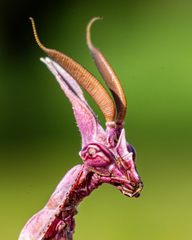
Thistle Mantis
Blepharopsis mendica · Order: Mantodea · Family: Empusidae
Also called: Arab Mantis, Devil's Flower Mantis, Egyptian Flower Mantis, Striped mantis

The adult thistle mantis can turn its head and thorax to show bright colours on its forelegs and hindwing undersides in a threat display. It lives among herbaceous plants and spiny bushes, where its colour helps it blend with leaves and dry desert vegetation. Its native range includes North Africa, the Mediterranean, the Middle East, southern Asia and the Canary Islands, covering many countries such as Egypt, Morocco, Iran, India and Turkey.
Source: Wikipedia
Where it lives
It inhabits terrestrial areas with herbaceous vegetation and spiny bushes. Its coloration provides camouflage that mimics leaves, spiny or dry desert plants.
Source: Wikipedia
Where it comes from
The species is native to North Africa, parts of the Mediterranean, the Middle East and southern Asia, as well as the Canary Islands.
Source: Wikipedia
More photos


Same family (Empusidae)


Sources
- Wikipedia: https://en.wikipedia.org/wiki/Blepharopsis
Look it up elsewhere: GBIF · iNaturalist · BugGuide · Wikipedia
Text written 2026-10-23 from the sources above and checked sentence by sentence against them. Data fetched 2026-10-23.