 Bug FAQ
Wandering Percher
Diplacodes bipunctata · Order: Odonata · Family: Libellulidae
Also called: Red Percher, Red Percher Dragonfly
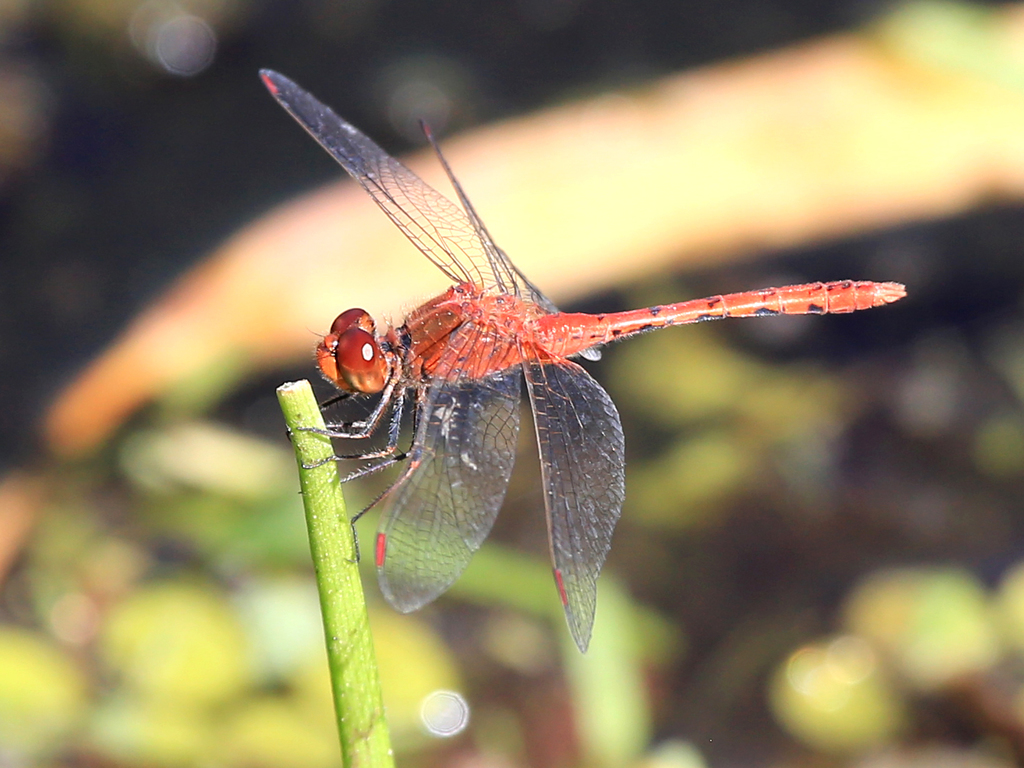
The wandering percher is a small to medium dragonfly with a wingspan around 55 mm. Males show a bright orange-red abdomen with dark dorsal and side markings, while females are yellowish with similar patterns. It lives near many types of freshwater pools, streams and swamps and is an early coloniser of fresh and brackish water habitats. The species occurs throughout mainland Australia (except Tasmania), New Zealand and several South-Pacific islands.
Source: Wikipedia
How to recognize it
Two dark spots are visible on the side of the synthorax, one being the metastigma.
Source: Wikipedia
Size
Wingspan is about 55 mm, placing it in the small to medium size range for dragonflies.
Source: Wikipedia
Where it lives
It is an early coloniser of suitable freshwater and brackish water habitats.
Source: Wikipedia
Where it comes from
Widespread in New Zealand and many South-Pacific islands. In Australia it occurs across the continent except Tasmania.
Source: Wikipedia
Where it is found in the US
Recorded in 1 of 51 states and DC. Most records: Kansas.
Darker = more records. Counts are museum and citizen-science records, not population size.
Source: GBIF
Same family (Libellulidae)

Sources
- Wikipedia: https://en.wikipedia.org/wiki/Diplacodes_bipunctata
Look it up elsewhere: GBIF · iNaturalist · BugGuide · Wikipedia
Text written 2026-10-22 from the sources above and checked sentence by sentence against them. Data fetched 2026-10-22.