 Bug FAQ
Wandering Pennant
Macrodiplax cora · Order: Odonata · Family: Libellulidae
Also called: Coastal Glider, Estuarine Skimmer

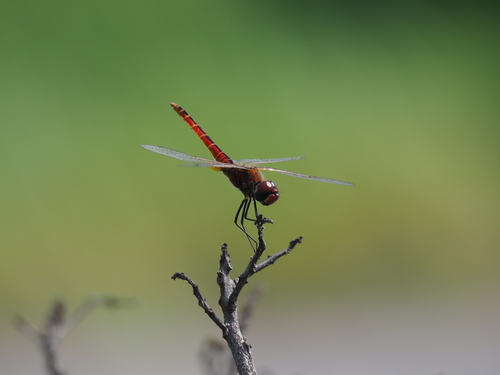
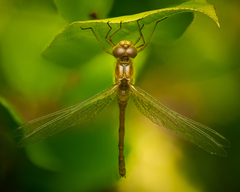
The wandering pennant is a medium-sized dragonfly about 45 mm long with a 75 mm wingspan. Males have a bright red abdomen with black hour-glass patches, brownish synthorax, clear wings with a yellow base on the hind wing, and bi-coloured legs. It lives near coastal lagoons, estuaries and swamps and is found across tropical Asia, Australasia and many islands.
Source: Wikipedia
How to recognize it
Males show a red abdomen marked with black hour-glass spots on each segment; females are less brightly coloured. The synthorax is brownish and may appear hairy, and the legs are two-toned. These features help tell it apart from other red dragonflies.
Source: Wikipedia
Size
Length about 45 mm and wingspan around 75 mm.
Source: Wikipedia
Where it lives
Prefers coastal lagoons, estuaries and swamps and tolerates some salt.
Source: Wikipedia
Life cycle
Undertakes migration and may be nomadic.
Source: Wikipedia
When you see it
Seasonal movements follow its migratory, nomadic behaviour.
Source: Wikipedia
Where it comes from
Widely distributed in tropical South Asia, Australia and many Indian and Pacific Ocean islands.
Source: Wikipedia
Lookalikes
Bi-coloured legs and hour-glass black patches on the abdomen distinguish it from other red dragonflies.
Source: Wikipedia
Where it is found in the US
Recorded in 1 of 51 states and DC. Most records: New York.
Darker = more records. Counts are museum and citizen-science records, not population size.
Source: GBIF
More photos
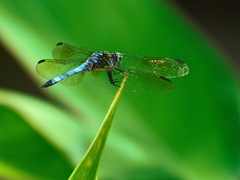
Same family (Libellulidae)

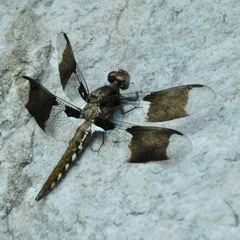
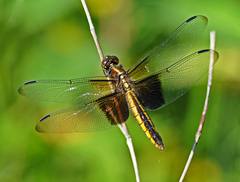

Sources
- Wikipedia: https://en.wikipedia.org/wiki/Macrodiplax_cora
Look it up elsewhere: GBIF · iNaturalist · BugGuide · Wikipedia
Text written 2026-10-23 from the sources above and checked sentence by sentence against them. Data fetched 2026-10-22.