 Bug FAQ
Wandering Donkey Acraea
Acraea neobule · Order: Lepidoptera · Family: Nymphalidae
Also called: Dancing Acraea, Glass-Tip Acraea, Neobule Acraea
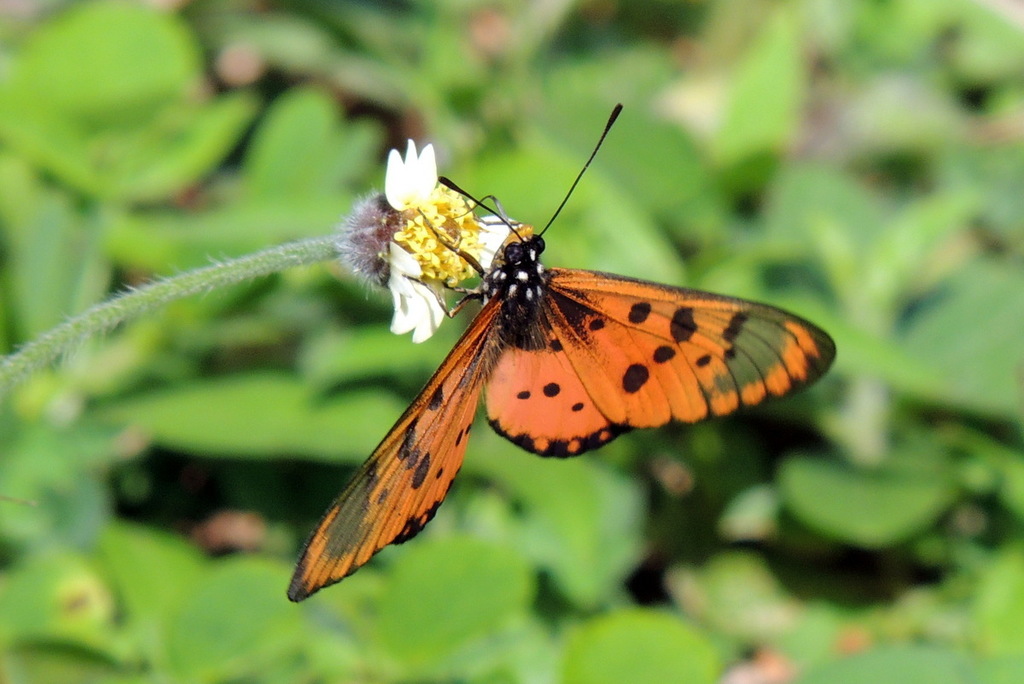
The wandering donkey acraea has a wingspan of about 48 to 56 mm, with females slightly larger than males. It lives across Sub-Saharan Africa and southwestern Arabia, where its caterpillars feed on passion-flower vines and related plants.
Source: Wikipedia
How to recognize it
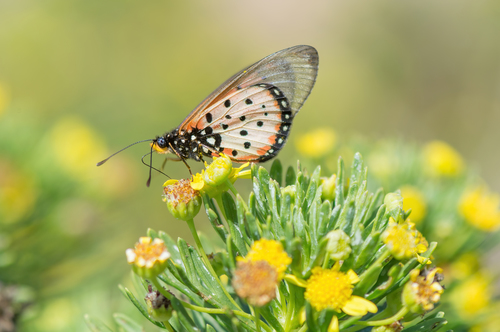
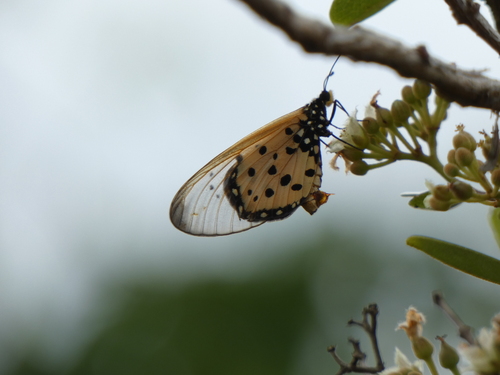
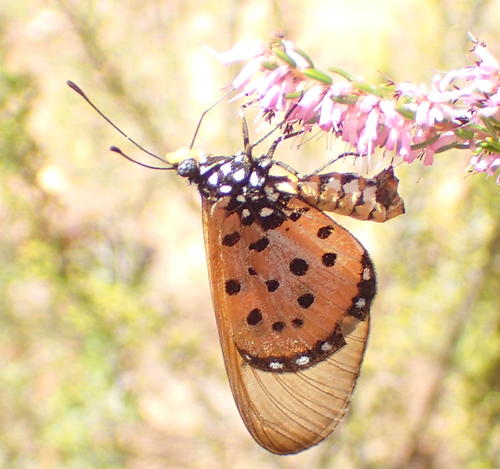
The forewing is thinly scaled with light orange-yellow up to the discal dots, leaving a transparent (hyaline) tip, and shows distinct spots and streaks near the cell. Both sides of the hindwing are orange-yellow with clear discal dots and a narrow marginal band about 1 to 1.5 mm wide that has rounded light spots.
Source: Wikipedia
Size
Males measure 48 to 55 mm in wingspan, while females are 50 to 56 mm.
Source: Wikipedia
Where it lives
It inhabits regions throughout Sub-Saharan Africa and the southwest of the Arabian Peninsula.
Source: Wikipedia
Life cycle
Adults are on the wing throughout the year, with higher numbers from September to April.
Source: Wikipedia
When you see it
The species can be seen flying year-round, but is most common between September and April.
Source: Wikipedia
Where it comes from
Its native range covers Sub-Saharan Africa and southwestern Arabia.
Source: Wikipedia
More photos

Same family (Nymphalidae)






Sources
- Wikipedia: https://en.wikipedia.org/wiki/Acraea_neobule
Look it up elsewhere: GBIF · iNaturalist · BugGuide · Wikipedia
Text written 2026-10-23 from the sources above and checked sentence by sentence against them. Data fetched 2026-10-23.