 Bug FAQ
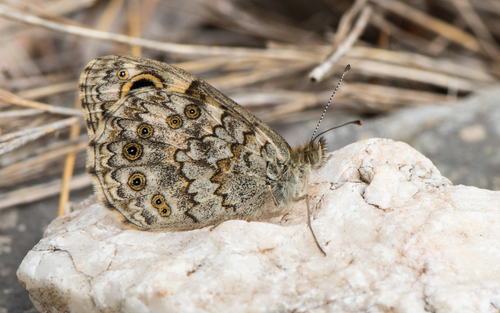
Wall Brown
Lasiommata megera · Order: Lepidoptera · Family: Nymphalidae
Also called: The Wall, Wall Butterfly

Wall Brown butterflies have a wingspan of about 3.6 to 5 cm and show a reddish-yellow band with a distinctive black line across the wings. They live in forest edges, clearings, shrubby ravines and mountain areas up to 3 000 m, and are found across North Africa, Europe, parts of Asia and the Middle East. The caterpillars eat various grasses, and adults fly from April to October, producing two or three generations depending on location.
Source: Wikipedia
How to recognize it
The upper side of the wings is reddish-yellow with a black mark that runs from the forewing cell to the hindwing edge, plus short black streaks across the forewing disc.
Source: Wikipedia
Size
Adults measure 36 to 50 mm (1.4 to 2.0 in) across the wings.
Source: Wikipedia
Where it lives
They inhabit forest edges, clearings, shrubby ravines, river valleys and sparse woodlands, up to 3 000 m altitude.
Source: Wikipedia
What it eats
Larvae feed on grasses such as Festuca, Bromus, Deschampsia, Poa, Dactylis and Brachypodium.
Source: Wikipedia
Life cycle
Eggs are pale green, almost spherical and finely ribbed; caterpillars become whitish-green with white dots when fully grown.
Source: Wikipedia
When you see it
The butterfly flies from April through October, with the number of generations varying by region.
Source: Wikipedia
More photos
Same family (Nymphalidae)






Sources
- Wikipedia: https://en.wikipedia.org/wiki/Lasiommata_megera
Look it up elsewhere: GBIF · iNaturalist · BugGuide · Wikipedia
Text written 2026-10-22 from the sources above and checked sentence by sentence against them. Data fetched 2026-10-22.