 Bug FAQ
Violet ground beetle
Carabus violaceus · Order: Coleoptera · Family: Carabidae
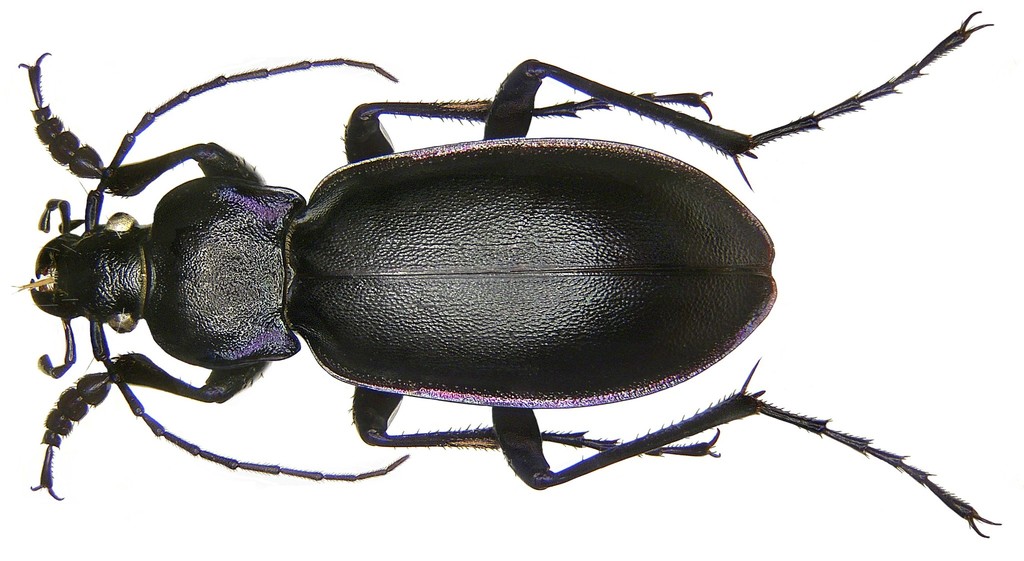
Violet ground beetles are 2 to 3 cm long, flightless, with a black head, thorax and abdomen edged in purple, and black legs, antennae and underside. They live in ancient and recent woodlands across the Euro-Siberian region and are sometimes eaten by birds such as jackdaws and blackbirds.
Source: Wikipedia
How to recognize it
The antennae are half the body length; the thorax is nearly heart-shaped and scalloped at the front; the elytra are smooth, joined and bear tiny bumps in indistinct lines.
Source: Wikipedia
Size
Adults measure between 2 and 3 cm (about 0.8 to 1.2 in) in length.
Source: Wikipedia
Where it lives
They inhabit both ancient and recent woodlands and some nearby habitats.
Source: Wikipedia
What it eats
Birds such as jackdaws and blackbirds sometimes feed on violet ground beetles.
Source: Wikipedia
Where it comes from
Their distribution covers the Euro-Siberian region, historically noted in European forests.
Source: Wikipedia
Lookalikes
It resembles Carabus problematicus, but has a more extensive purple coloration on the pronotum.
Source: Wikipedia
Where it is found in the US
Recorded in 1 of 51 states and DC. Most records: Kansas.
Darker = more records. Counts are museum and citizen-science records, not population size.
Source: GBIF
Questions people ask
How can I identify a violet ground beetle?
Look for a 2 to 3 cm long, flightless beetle with a black head, thorax and abdomen edged in purple, black legs and antennae half the body length, and smooth elytra with tiny bumps.
Source: Wikipedia
Where does the violet ground beetle live?
It lives in both ancient and recent woodlands across the Euro-Siberian region.
Source: Wikipedia
Same family (Carabidae)


Sources
- Wikipedia: https://en.wikipedia.org/wiki/Carabus_violaceus
Look it up elsewhere: GBIF · iNaturalist · BugGuide · Wikipedia
Text written 2026-10-22 from the sources above and checked sentence by sentence against them. Data fetched 2026-10-22.