 Bug FAQ
Viceroy
Limenitis archippus · Order: Lepidoptera · Family: Nymphalidae

The viceroy butterfly has orange and black wings and is smaller than a monarch, with a distinctive black line on the hindwing veins. Its range covers most of the contiguous United States, parts of Canada and Mexico, but it may no longer be present in California. Caterpillars eat willows, poplars and cottonwoods, store bitter salicylic acid, and look like bird droppings for protection.
Source: Wikipedia
How to recognize it
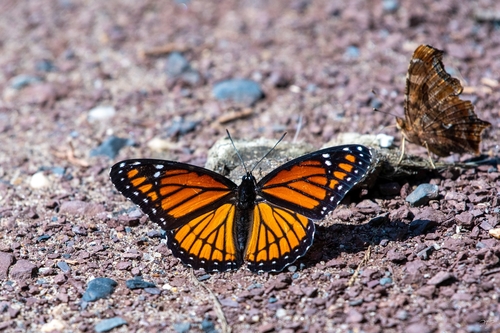
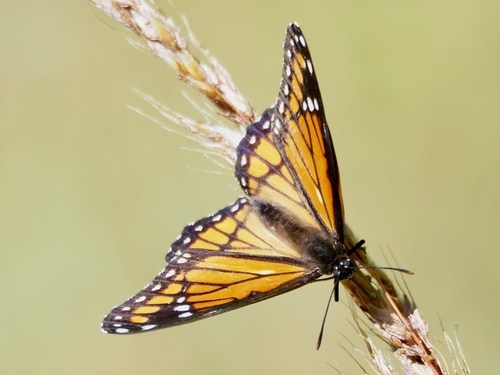
The wings show an orange and black pattern. A post-median black line runs across the hindwing veins, helping tell it apart from a monarch.
Source: Wikipedia
Size
Wingspan ranges from about 53 mm to 81 mm (2.1 to 3.2 in).
Source: Wikipedia
Where it lives
It lives across most of the lower 48 states, parts of Canada and Mexico, though it may be gone from California.
Source: Wikipedia
What it eats
Caterpillars feed on willow family trees, including willows, poplars and cottonwoods. Adults fly in daylight, especially late morning to early afternoon, and sip nectar from milkweeds, thistles and other common flowers.
Source: Wikipedia
Life cycle
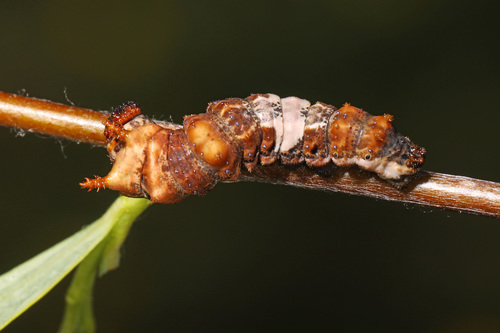
Caterpillars store salicylic acid, making them bitter and upsetting predators' stomachs. Both the caterpillars and their chrysalises look like bird droppings for extra protection.
Source: Wikipedia
When you see it
Adults are active during the day, preferring late morning and early afternoon.
Source: Wikipedia
Where it comes from
Its western edge runs from the Northwest Territories down the eastern slopes of the Cascades and Sierra Nevada into central Mexico; the eastern edge follows the Atlantic and Gulf coasts from Nova Scotia to Texas.
Source: Wikipedia
Lookalikes
In Florida, Georgia, the Southwest US and Mexico it shares wing patterns with the queen and soldier butterflies.
Source: Wikipedia
Where it is found in the US
Recorded in 49 of 51 states and DC. Most records: Illinois, Texas, Florida, Ohio, Vermont, Michigan, New York, Wisconsin.
Darker = more records. Counts are museum and citizen-science records, not population size.
Source: GBIF
Status: native in North America; native in Canada; native in United States. Source: iNaturalist
Months it is reported in the US
Source: GBIF
More photos
Same family (Nymphalidae)






Sources
- Wikipedia: https://en.wikipedia.org/wiki/Viceroy_%28butterfly%29
Look it up elsewhere: GBIF · iNaturalist · BugGuide · ITIS · Wikipedia
Text written 2026-10-22 from the sources above and checked sentence by sentence against them. Data fetched 2026-10-22.