 Bug FAQ
Variable mirid
Calocoris nemoralis · Order: Hemiptera · Family: Miridae

Adults are 8.2 to 9.5 mm long, with an elongated body and dense black hairs on the back. They live in southern Europe on thistles such as Cirsium, Carduus and Silybum, and are seen from June to September.
Source: Wikipedia
Size
Males reach 8.5 to 9 mm and females 8.2 to 9.5 mm in length. The body shape is elongated.
Source: Wikipedia
What it eats
Feeds on thistles such as Cirsium, Carduus and Silybum species.
Source: Wikipedia
Life cycle
Eggs overwinter before hatching.
Source: Wikipedia
When you see it
Adults are present from June through September.
Source: Wikipedia
Where it comes from
Its range covers the same southern European countries listed for habitat.
Source: Wikipedia
Lookalikes
Several forms exist, including f. bimaculata, f. hexastigma, f. hispanica, f. picea, f. nigrovittata, f. erytrocephala and f. vittata.
Source: Wikipedia
Where it is found in the US
Recorded in 1 of 51 states and DC. Most records: New York.
Darker = more records. Counts are museum and citizen-science records, not population size.
Source: GBIF
More photos
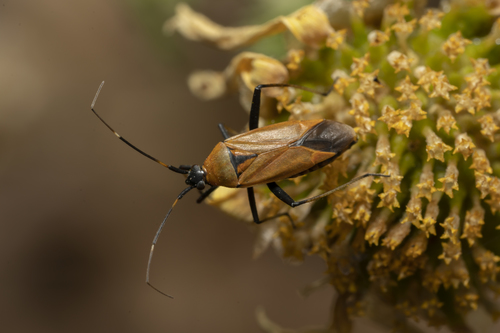
Questions people ask
How big are Calocoris nemoralis bugs?
Males are about 8.5 to 9 mm long and females 8.2 to 9.5 mm.
Source: Wikipedia
What plants do they live on?
They mainly live on thistles such as Cirsium, Carduus and Silybum.
Source: Wikipedia
Where are they found?
They occur in most of southern Europe, including countries like France, Italy and Spain.
Source: Wikipedia
Same family (Miridae)
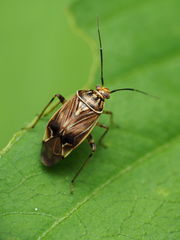 North American Tarnished Plant BugLygus lineolarisDamages trees, gardens or crops
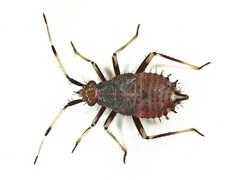 Red-spotted Plant BugDeraeocoris ruber
 Alfalfa Plant BugAdelphocoris lineolatusDamages trees, gardens or crops
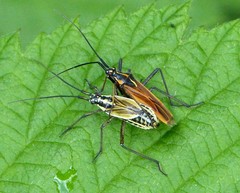 Meadow Plant BugLeptopterna dolabrataDamages trees, gardens or crops
 Four-lined Plant BugPoecilocapsus lineatusDamages trees, gardens or crops
 Lygus pratensisLygus pratensisDamages trees, gardens or crops
Sources
- Wikipedia: https://en.wikipedia.org/wiki/Calocoris_nemoralis
Look it up elsewhere: GBIF · iNaturalist · BugGuide · Wikipedia
Text written 2026-10-23 from the sources above and checked sentence by sentence against them. Data fetched 2026-10-22.