 Bug FAQ
Four-lined Plant Bug
Poecilocapsus lineatus · Order: Hemiptera · Family: Miridae
Also called: 4-lined plant bug, Fourlined Plant Bug
Source: Wikipedia

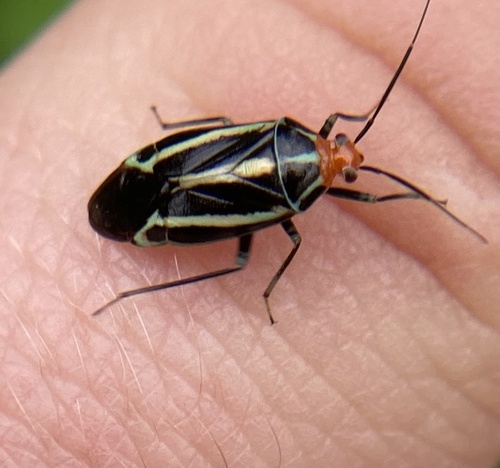
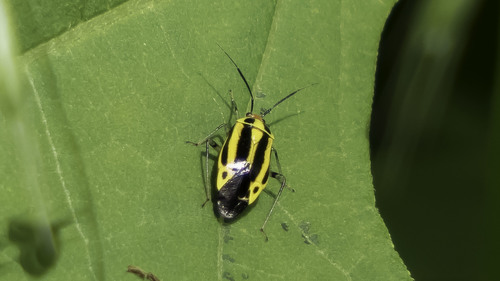
Adults are about 7 mm long, 3.5 mm wide, with four black lines on a green-yellow body, an orange head and dark red eyes.
Source: Wikipedia
How to recognize it
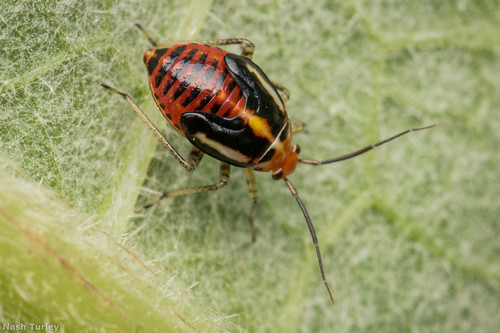
Nymphs are bright red with black markings, and the last instar turns bright orange.
Source: Wikipedia
Size
Adults measure about 7 to 7.5 mm in length and 3.5 mm in width.
Source: Wikipedia
Is it a pest in the house?
It is considered a minor pest, occasionally damaging herbaceous plants, especially mints, and rarely affecting woody shrubs or small trees.
Source: Wikipedia
Where it lives
They prefer plants in the mint (Lamiaceae) and composite (Asteraceae) families, including many herbaceous perennials and shrubs.
Source: Wikipedia
What it eats
Both nymphs and adults feed on leaf tissue, causing water-soaked spots that may later dry or form tiny holes.
Source: Wikipedia
Life cycle
It has one generation per year and overwinters as eggs that hatch in mid to late spring.
Source: Wikipedia
When you see it
Plant damage occurs from late spring to early summer; eggs hatch mid-late April and adults appear by late May in southern Pennsylvania.
Source: Wikipedia
Where it is found in the US
Recorded in 41 of 51 states and DC. Most records: Texas, Ohio, New York, Illinois, Michigan, Pennsylvania, Minnesota, Virginia.
Darker = more records. Counts are museum and citizen-science records, not population size.
Source: GBIF
Status: native in North America; native in United States; native in Canada. Source: iNaturalist
Months it is reported in the US
Source: GBIF
More photos

Questions people ask
What plants are most at risk?
Mints and other members of the mint and composite families are most frequently damaged.
Source: Wikipedia
When will I see the most damage?
Damage peaks in late spring to early summer as nymphs feed on leaves.
Source: Wikipedia
Same family (Miridae)
 North American Tarnished Plant BugLygus lineolarisDamages trees, gardens or crops
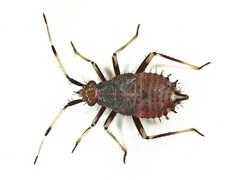 Red-spotted Plant BugDeraeocoris ruber
 Alfalfa Plant BugAdelphocoris lineolatusDamages trees, gardens or crops
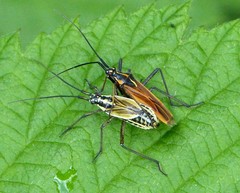 Meadow Plant BugLeptopterna dolabrataDamages trees, gardens or crops
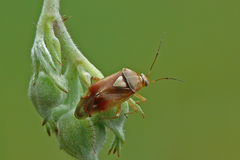 Lygus pratensisLygus pratensisDamages trees, gardens or crops
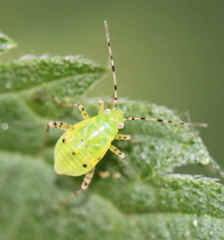 Three Spotted Nettle BugLiocoris tripustulatus
Sources
- Wikipedia: https://en.wikipedia.org/wiki/Poecilocapsus_lineatus
Look it up elsewhere: GBIF · iNaturalist · BugGuide · ITIS · Wikipedia
Text written 2026-10-22 from the sources above and checked sentence by sentence against them. Data fetched 2026-10-22.