 Bug FAQ
Tyde's Sand Wasp
Podalonia tydei · Order: Hymenoptera · Family: Sphecidae
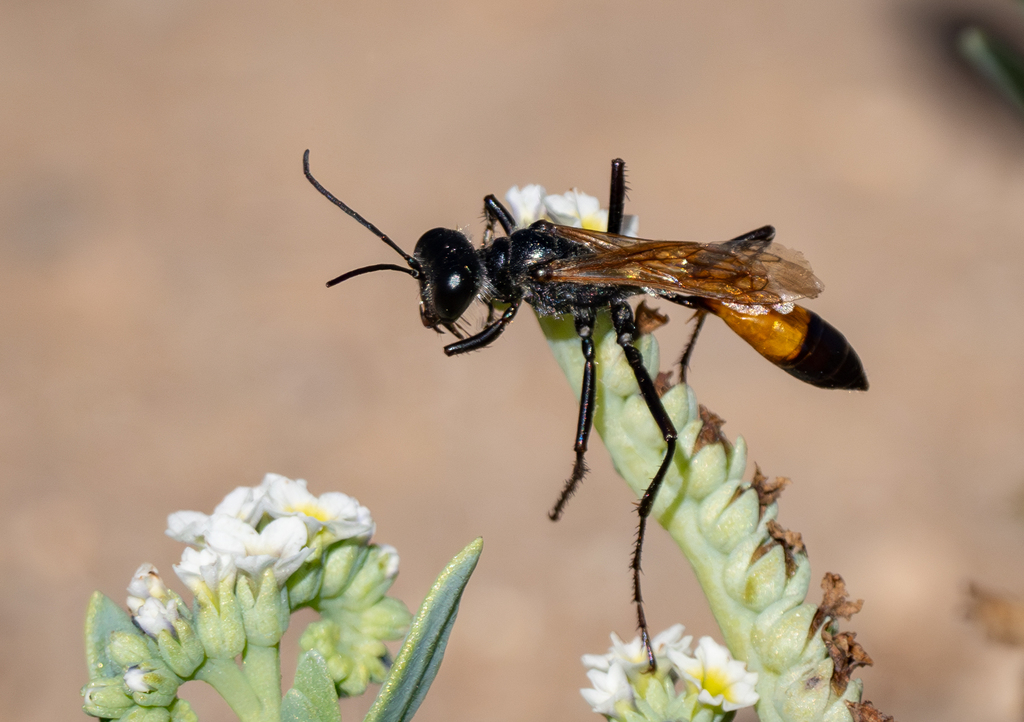
Adult females reach about 22 mm and males about 18 mm in length. The wasp is black on the head, mesosoma, legs and rear half of the abdomen, with the front half of the abdomen reddish-brown and covered in fine silver-white hairs.
Source: Wikipedia
How to recognize it
Head, mesosoma, legs and the back half of the abdomen are black, while the front half of the abdomen is a fulvous-red colour. Fine silver-white hairs cover the head, the coxae and the abdomen.
Source: Wikipedia
Size
Females grow to about 22.2 mm long; males reach up to 17.5 mm.
Source: Wikipedia
Where it lives
Found in exposed sand habitats, especially coastal dunes.
Source: Wikipedia
What it eats
Females search the ground for Agrotis innominata larvae to use as hosts for their eggs. Each nest holds a single parasitised caterpillar on which the female lays her eggs.
Source: Wikipedia
Life cycle
Nests are dug after the prey is collected and contain only one cell. Mating occurs in March, with males gripping the female’s neck with their mandibles.
Source: Wikipedia
When you see it
Adults are active in bright sunshine and disappear when it becomes overcast.
Source: Wikipedia
Where it is found in the US
Recorded in 1 of 51 states and DC. Most records: New York.
Darker = more records. Counts are museum and citizen-science records, not population size.
Source: GBIF
Same family (Sphecidae)
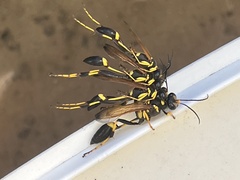 Yellow-legged Mud-dauber WaspSceliphron caementariumCan sting
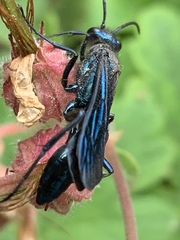 Common Blue Mud-dauber WaspChalybion californicumCan sting
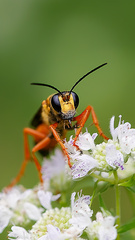 Great Golden Digger WaspSphex ichneumoneus
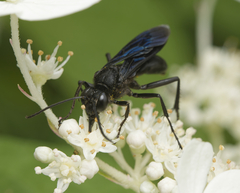 Great Black Digger WaspSphex pensylvanicusCan sting
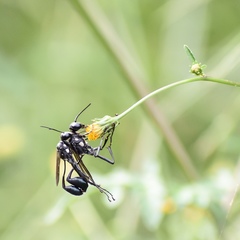 Gold-marked Thread-waisted WaspEremnophila aureonotata
 Mexican Grass-carrying WaspIsodontia mexicana
Sources
- Wikipedia: https://en.wikipedia.org/wiki/Podalonia_tydei
Look it up elsewhere: GBIF · iNaturalist · BugGuide · ITIS · Wikipedia
Text written 2026-10-23 from the sources above and checked sentence by sentence against them. Data fetched 2026-10-22.