 Bug FAQ
Great Black Digger Wasp
Sphex pensylvanicus · Order: Hymenoptera · Family: Sphecidae
Also called: Great Black Wasp
Source: Wikipedia

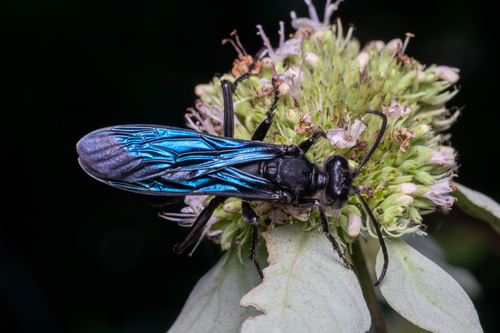
Great Black Digger Wasp is a large, entirely black wasp with smoky, blue-iridescent wings. It lives across most of North America, from the contiguous United States into southern Canada and northern Mexico.
Source: Wikipedia
Size
Females are 25 to 34 mm long, while males are smaller at 19 to 28 mm.
Source: Wikipedia
Does it bite or sting?
The wasp’s sting is painful but does not cause swelling like many other stings.
Source: Wikipedia
Where it lives
The species is found throughout most of North America. Females dig underground nests and stock them with orthopteran insects.
Source: Wikipedia
What it eats
Adults capture living orthopteran insects, especially Microcentrum, Amblycorypha and Scudderia, to feed their larvae. Larvae eat the paralyzed prey that the female provides.
Source: Wikipedia
Life cycle
The larval stage lasts roughly 10 days, growing to 30 to 35 mm before pupating.
Source: Wikipedia
Where it comes from
Its historic range covers the contiguous United States and northern Mexico. In the late 20th century it expanded north into New York, Quebec and Ontario.
Source: Wikipedia
Where it is found in the US
Recorded in 45 of 51 states and DC. Most records: Massachusetts, Illinois, New York, Minnesota, Wisconsin, Texas, Vermont, North Carolina.
Darker = more records. Counts are museum and citizen-science records, not population size.
Source: GBIF
Status: native in North America; native in United States; native in Canada. Source: iNaturalist
Months it is reported in the US
Source: GBIF
More photos

Questions people ask
Do they bite people?
They can sting. The sting is painful but does not swell like other wasp stings.
Source: Wikipedia
Same family (Sphecidae)
 Yellow-legged Mud-dauber WaspSceliphron caementariumCan sting
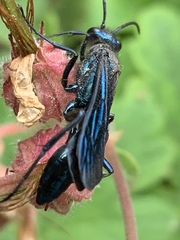 Common Blue Mud-dauber WaspChalybion californicumCan sting
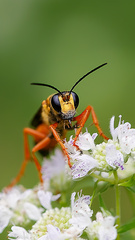 Great Golden Digger WaspSphex ichneumoneus
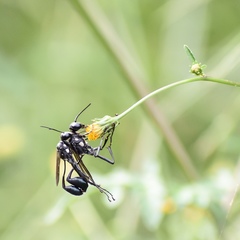 Gold-marked Thread-waisted WaspEremnophila aureonotata
 Mexican Grass-carrying WaspIsodontia mexicana
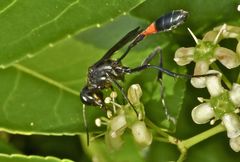 Common Thread-waisted WaspAmmophila procera
Sources
- Wikipedia: https://en.wikipedia.org/wiki/Sphex_pensylvanicus
Look it up elsewhere: GBIF · iNaturalist · BugGuide · ITIS · Wikipedia
Text written 2026-10-22 from the sources above and checked sentence by sentence against them. Data fetched 2026-10-22.