 Bug FAQ
Two-spotted Pleasing Fungus Beetle
Tritoma biguttata · Order: Coleoptera · Family: Erotylidae
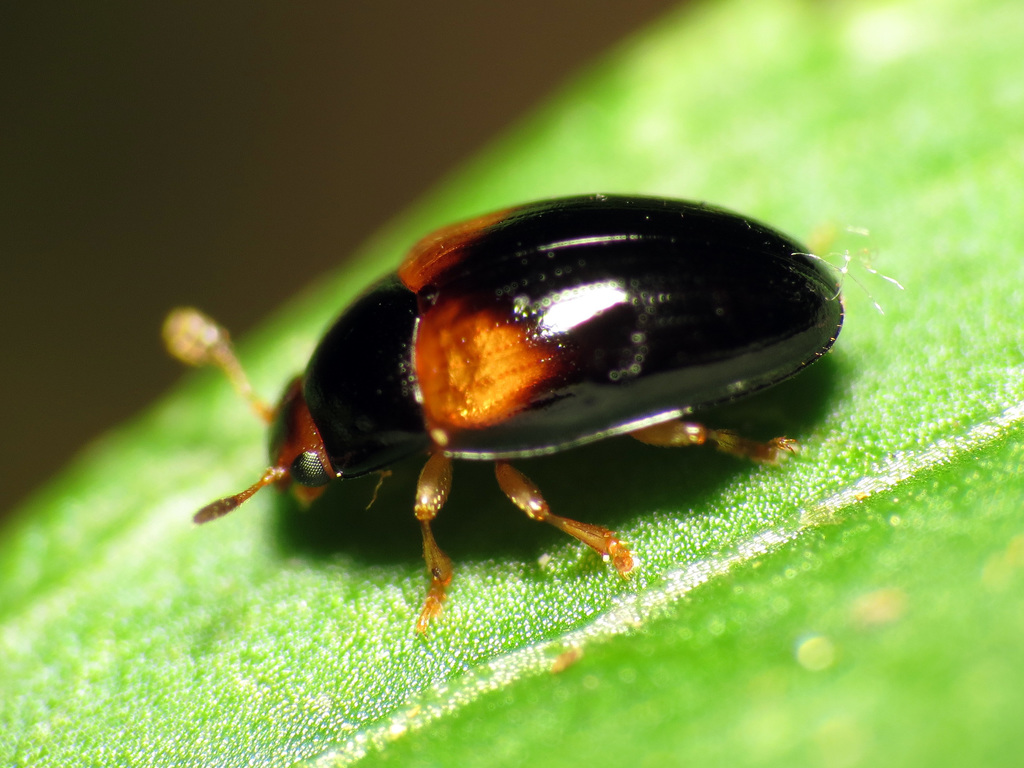
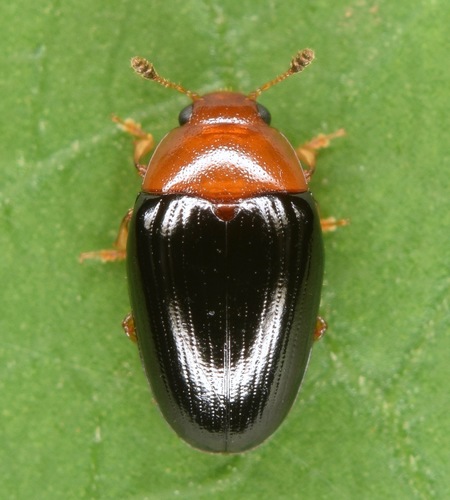
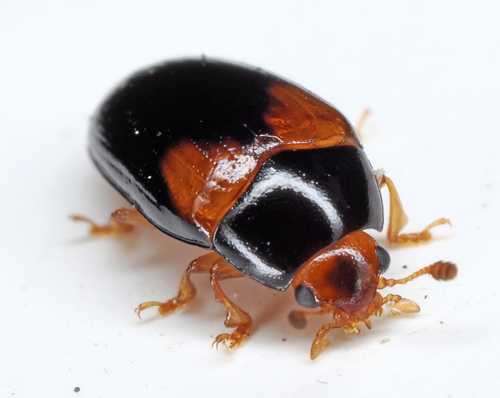
Each wing cover has a large triangular orange-red spot that starts near the scutellum and extends toward the rear, covering 25 to 50 % of the elytron. Adults are most often seen in the hot summer months.
Source: Wikipedia
Size
Adults measure roughly 2.7 to 4.4 mm in length and 1.5 to 2.6 mm in width.
Source: Wikipedia
Where it lives
The beetle is most often encountered during the hot summer months when adults are active.
Source: Wikipedia
When you see it
Adults are most frequently seen in the warm summer period.
Source: Wikipedia
Where it comes from
It is a North American species of pleasing fungus beetle.
Source: Wikipedia
Lookalikes
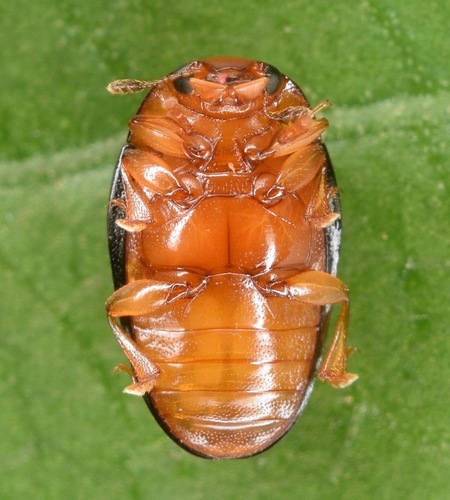
It can be confused with T. humeralis, which has a black underside and wing spots that are farther apart and less triangular. It also resembles T. angulata, which is overall darker, has a black underside, and shows prominently expanded tibia tips.
Source: Wikipedia
Where it is found in the US
Recorded in 23 of 51 states and DC. Most records: Georgia, Florida, Alabama, Pennsylvania, Massachusetts, New York, Kansas, Mississippi.
Darker = more records. Counts are museum and citizen-science records, not population size.
Source: GBIF
Status: native in North America; native in Canada; native in United States. Source: iNaturalist
Months it is reported in the US
Source: GBIF
More photos
Questions people ask
How can I tell this beetle apart from similar species?
Look for the orange underside and the dark reddish-brown clubs on the antennae; T. humeralis has a black underside and less triangular wing spots, while T. angulata is darker overall and has expanded tibia tips.
Source: Wikipedia
Same family (Erotylidae)
 Blue Fungus BeetleGibbifer californicus
 Pleasing Fungus BeetleMegalodacne heros
 Red-banded Fungus BeetleMegalodacne fasciata
 Four-spotted Fungus BeetleIschyrus quadripunctatus
 Clover Stem BorerLanguria mozardiDamages trees, gardens or crops
 Slender Lizard BeetleAcropteroxys gracilisDamages trees, gardens or crops
Sources
- Wikipedia: https://en.wikipedia.org/wiki/Tritoma_biguttata
Look it up elsewhere: GBIF · iNaturalist · BugGuide · ITIS · Wikipedia
Text written 2026-10-25 from the sources above and checked sentence by sentence against them. Data fetched 2026-10-25.