 Bug FAQ
Four-spotted Fungus Beetle
Ischyrus quadripunctatus · Order: Coleoptera · Family: Erotylidae
Also called: Little Pleasing Fungus Beetle
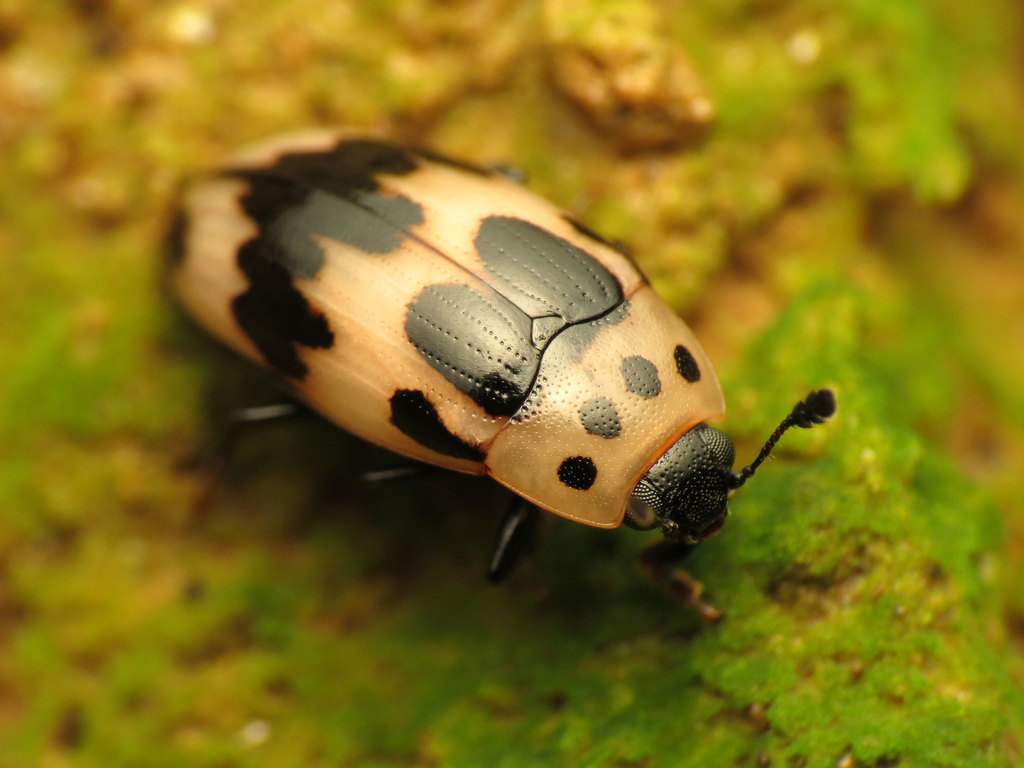
The four-spotted fungus beetle is a small beetle about 5 to 9 mm long with a black and pale orange pattern and four dark spots on a light pronotum. It lives in woodlands across North America down to South America and on several Caribbean islands, feeding on soft-fleshed polypore fungi such as Oxyporus latemarginatus.
Source: Wikipedia
How to recognize it
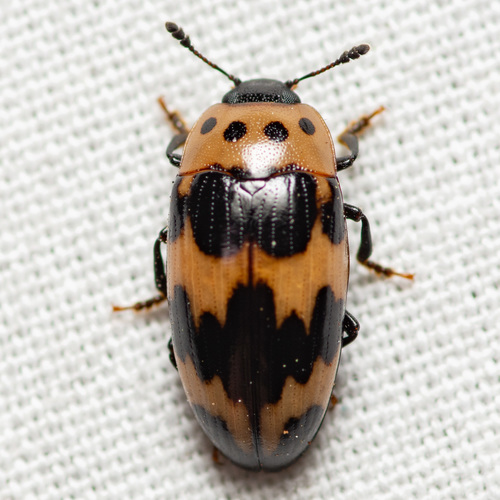
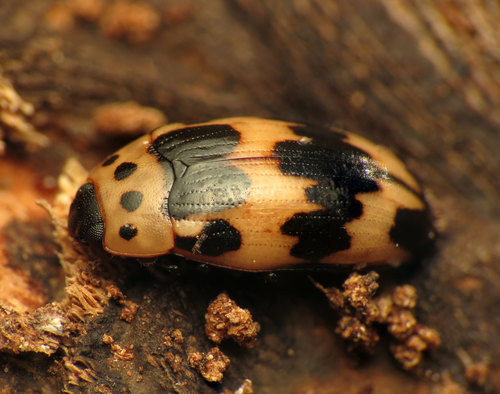
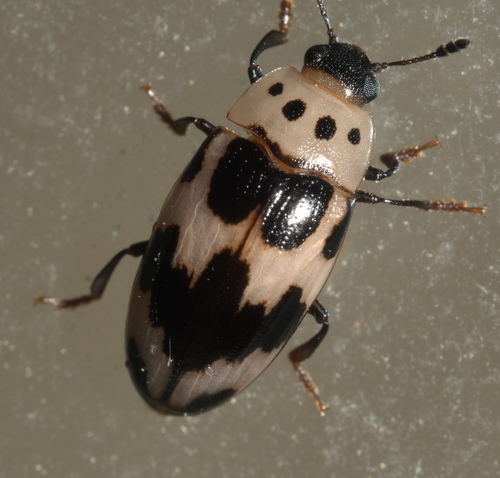
Adults have a black and pale orange color pattern with four dark spots forming a slightly concave transverse band on the light pronotum.
Source: Wikipedia
Where it lives
It is a woodland species found in oak, baldcypress, pine, and even introduced orange trees.
Source: Wikipedia
What it eats
Both adults and larvae eat the fungi they inhabit, especially soft-fleshed polypores like the white-rot fungus Oxyporus latemarginatus.
Source: Wikipedia
Life cycle
Adults and larvae feed together on the same fungal growths, often seen in sizable groups.
Source: Wikipedia
Where it comes from
It occurs throughout the United States and Canada, extending south to Paraguay and northern Argentina, with records from St. Vincent and St. Lucia in the Caribbean.
Source: Wikipedia
Lookalikes
It is not as pale as some related beetles, which helps separate it from similar species.
Source: Wikipedia
Where it is found in the US
Recorded in 35 of 51 states and DC. Most records: Texas, Kansas, Maryland, Ohio, Alabama, North Carolina, Missouri, Virginia.
Darker = more records. Counts are museum and citizen-science records, not population size.
Source: GBIF
Status: native in North America; native in Canada; native in United States. Source: iNaturalist
Months it is reported in the US
Source: GBIF
More photos

Questions people ask
How can I tell this beetle apart from similar species?
Look for four dark spots forming a slightly concave band on a light pronotum; the beetle is also not as pale as some relatives.
Source: Wikipedia
When are adults most likely to be seen?
Adults are out whenever it is warm, with peak activity in hot summer months in Canada and from May to mid-August in Nebraska; in central Texas they may be active nearly all year.
Source: Wikipedia
What do these beetles eat?
Both adults and larvae feed on soft-fleshed polypore fungi, especially the white-rot fungus Oxyporus latemarginatus.
Source: Wikipedia
Where does this beetle live?
It lives in woodland habitats across the United States and Canada, down through South America to Paraguay and northern Argentina, and on some Caribbean islands.
Source: Wikipedia
Same family (Erotylidae)


Sources
- Wikipedia: https://en.wikipedia.org/wiki/Ischyrus_quadripunctatus
Look it up elsewhere: GBIF · iNaturalist · BugGuide · ITIS · Wikipedia
Text written 2026-10-23 from the sources above and checked sentence by sentence against them. Data fetched 2026-10-23.