 Bug FAQ
Red-banded Fungus Beetle
Megalodacne fasciata · Order: Coleoptera · Family: Erotylidae

Adults are 10 to 15.5 mm long and 5 to 6 mm wide, making them among the largest pleasing fungus beetles. They live on bracket fungi, especially Ganoderma lucidum, growing on dead logs and stumps in eastern North America.
Source: Wikipedia
Size
Adults measure 10 to 15.5 mm in length and 5 to 6 mm in width, ranking them as the second-largest in their group.
Source: Wikipedia
Where it lives
They are found on bracket fungi on dead wood, preferring Ganoderma species such as the lacquered bracket G. lucidum.
Source: Wikipedia
Life cycle
The larval ecology of this beetle has been described in detail, unlike many related species.
Source: Wikipedia
When you see it
Adults are most common in summer, are active at night, and are attracted to bright lights.
Source: Wikipedia
Where it comes from
The species is essentially limited to the United States east of the 100th meridian, with a few records in Ontario and Québec along the St. Lawrence River.
Source: Wikipedia
Lookalikes
The western relative M. heros is larger (up to 23 mm) and has a more rectangular pronotum with larger shoulder blotches that often meet at the elytral midline.
Source: Wikipedia
Where it is found in the US
Recorded in 33 of 51 states and DC. Most records: Texas, Kentucky, Ohio, Oklahoma, Florida, Virginia, Pennsylvania, Missouri.
Darker = more records. Counts are museum and citizen-science records, not population size.
Source: GBIF
Status: native in North America; native in Canada; native in United States. Source: iNaturalist
Months it is reported in the US
Source: GBIF
More photos
Questions people ask
What does the Red-banded Fungus Beetle look like?
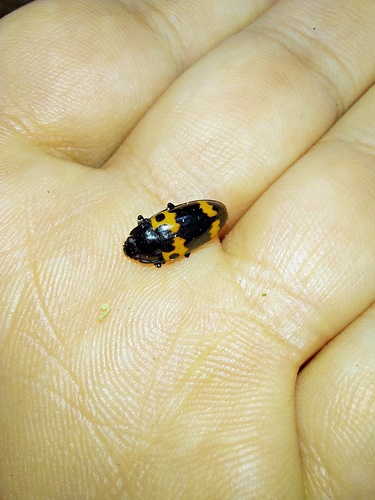
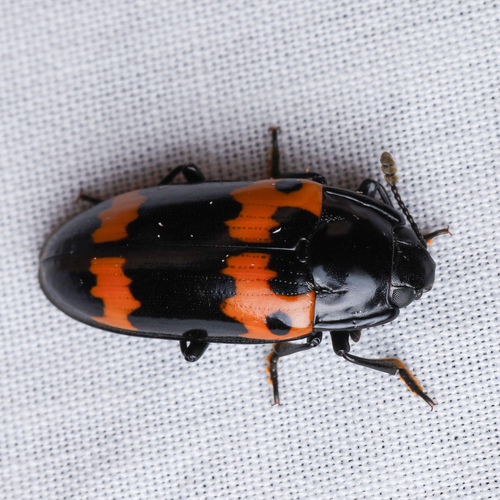
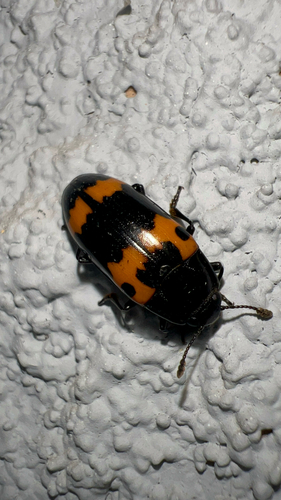
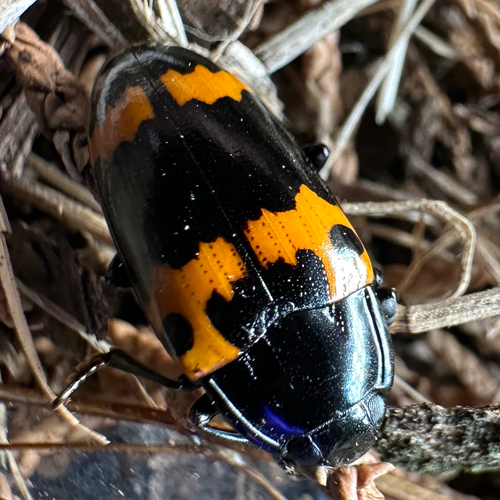
It is mostly black with a jagged orange band near the wing tip and orange irregular spots on each shoulder.
Source: Wikipedia
When are they active?
They are most plentiful in summer, are active at night, and are attracted to bright lights.
Source: Wikipedia
Where can I find them?
They occur on bracket fungi on dead logs and stumps in the eastern United States, with occasional records in Ontario and Québec.
Source: Wikipedia
Same family (Erotylidae)


Sources
- Wikipedia: https://en.wikipedia.org/wiki/Megalodacne_fasciata
Look it up elsewhere: GBIF · iNaturalist · BugGuide · ITIS · Wikipedia
Text written 2026-10-23 from the sources above and checked sentence by sentence against them. Data fetched 2026-10-23.