 Bug FAQ
Tufted Potter Wasp
Symmorphus cristatus · Order: Hymenoptera · Family: Eumenidae
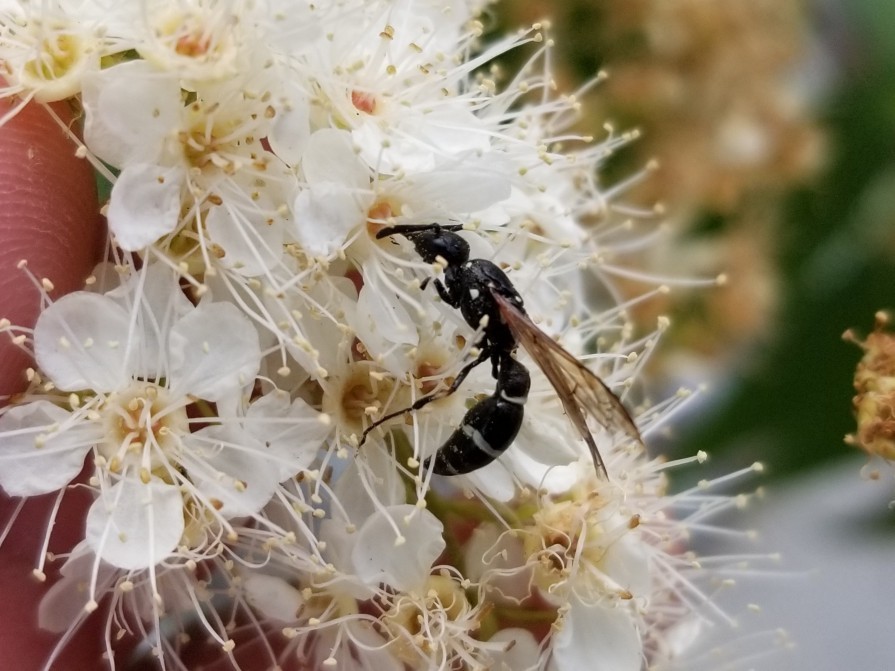
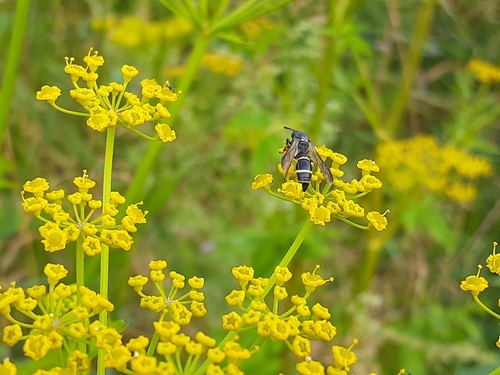
Wing length ranges from 5 to 9 mm and males are about 20 % smaller than females; body markings vary from pale to yellow. Females build mud-lined nests in 5 mm holes in dead wood, often in lodgepole pine logs in the eastern Sierra Nevada. They hunt leaf-beetle larvae such as Gonioctena americana and Chrysomela species to feed their young.
Source: Wikipedia
How to recognize it
The hind-leg femur bears conspicuous hairs, which S. canadensis lacks.
Source: Wikipedia
Where it lives
They are found where adult floral resources, dead trees or logs, and chrysomelid beetle larvae are available. Females make nests in holes about 5 mm wide, frequently in lodgepole pine trees or logs in the eastern Sierra Nevada.
Source: Wikipedia
What it eats
It preys on larvae of leaf beetles. Recorded prey include Gonioctena americana, Chrysomela scripta, C. crotchi, C. aeneicollis, C. schaefferi, and Plagiodera californica.
Source: Wikipedia
Life cycle
Like other Eumeninae, they construct mud or clay nests where the larvae are supplied with prey.
Source: Wikipedia
When you see it
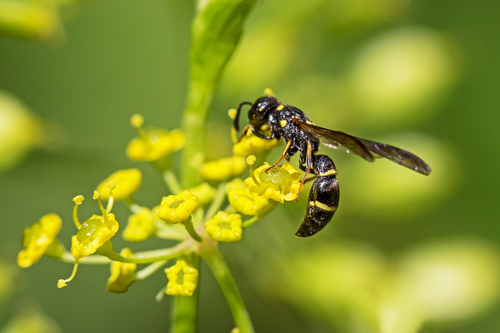
In Illinois, adults have been seen visiting a variety of flowers. In the eastern Sierra Nevada, adults feed on nectar from Apiaceae plants.
Source: Wikipedia
Where it comes from
It also occurs in northern and mountainous regions of the United States.
Source: Wikipedia
Lookalikes
It is one of three Symmorphus species in North America and can be distinguished by its narrower metasomal tergum, closer cephalic foveae, and hairy hind-leg femur.
Source: Wikipedia
Where it is found in the US
Recorded in 16 of 51 states and DC. Most records: Alaska, Illinois, Utah, Colorado, Indiana, Virginia, New York, Pennsylvania.
Darker = more records. Counts are museum and citizen-science records, not population size.
Source: GBIF
Status: native in North America; native in United States; native in Canada. Source: iNaturalist
Months it is reported in the US
Source: GBIF
More photos
Questions people ask
What do these wasps eat?
They hunt leaf-beetle larvae such as Gonioctena americana and several Chrysomela species to feed their young.
Source: Wikipedia
Where do they build their nests?
Females construct mud-lined nests in holes about 5 mm wide in dead wood, often in lodgepole pine logs in the eastern Sierra Nevada.
Source: Wikipedia
When are they active?
Adults are seen on flowers in Illinois and feed on Apiaceae nectar in the eastern Sierra Nevada during the warm months.
Source: Wikipedia
How can I tell this wasp apart from similar species?
Look for a narrower metasomal tergum with closely spaced cephalic foveae and conspicuous hairs on the hind-leg femur, features that differ from S. albomarginatus and S. canadensis.
Source: Wikipedia
Same family (Eumenidae)

Sources
- Wikipedia: https://en.wikipedia.org/wiki/Symmorphus_cristatus
Look it up elsewhere: GBIF · iNaturalist · BugGuide · Wikipedia
Text written 2026-10-29 from the sources above and checked sentence by sentence against them. Data fetched 2026-10-29.