 Bug FAQ
Tritoma humeralis
Tritoma humeralis · Order: Coleoptera · Family: Erotylidae
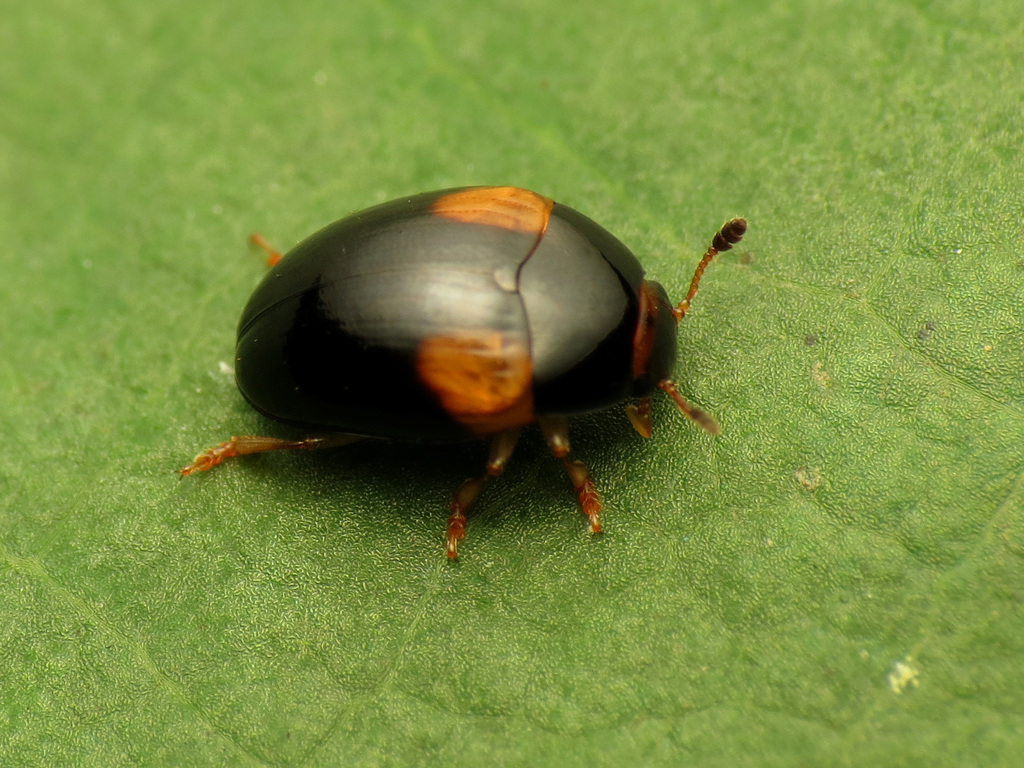
It is mostly black with orange-red spots on the elytral shoulders and orange legs and antenna stalks. The species lives east of the Rockies from New England and Quebec down to the Carolinas and Alabama, but not on the Gulf Coast.
Source: Wikipedia
How to recognize it
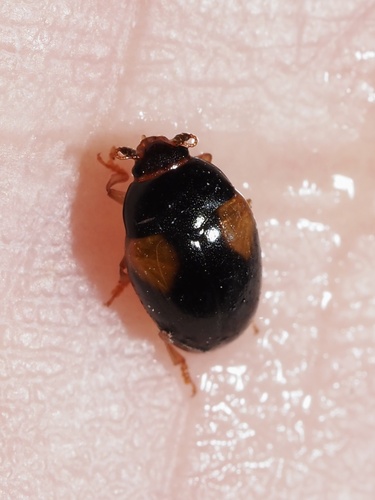
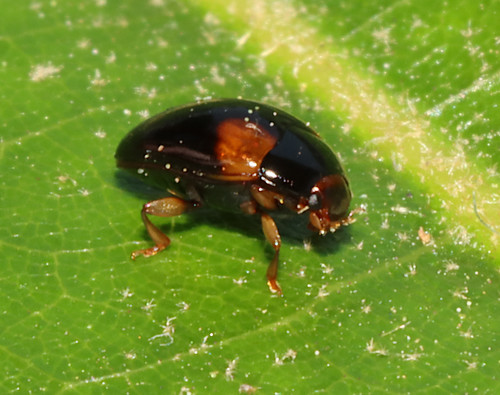
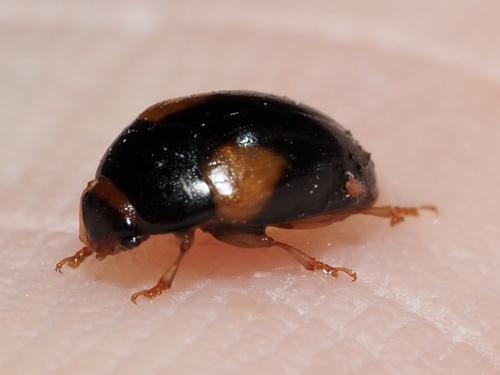
The beetle is mainly black, with a slightly lighter area at the base of the head and the tip of the abdomen. Each elytron has a large orange-red spot near the shoulder and the legs and antenna stalks are orange, though the leg coxae and trochanters are often darker.
Source: Wikipedia
Size
Adults measure between 2.4 and 4.2 mm in length and 1.5 to 2.6 mm in width.
Source: Wikipedia
Where it lives
It occurs throughout eastern North America, from New England and Quebec down to South Carolina, northern Georgia, Alabama, Arkansas and possibly Texas.
Source: Wikipedia
Life cycle
After emerging from the pupa, the head capsule and pleura stay orange while the rest of the dark carapace hardens later.
Source: Wikipedia
Where it comes from
The type locality is the historic “Carolina” region, which today includes North Carolina, South Carolina and Tennessee. Overall its native range is the eastern United States east of the Rockies.
Source: Wikipedia
Lookalikes
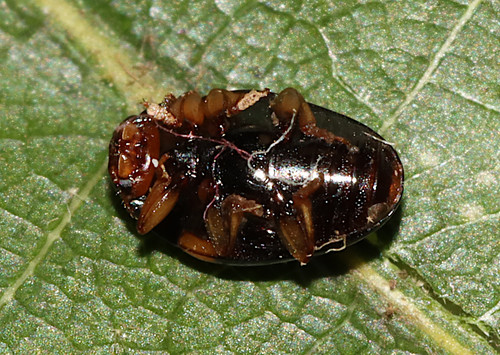
It looks very similar to Tritoma biguttata, but T. biguttata has an orange underside.
Source: Wikipedia
Where it is found in the US
Recorded in 24 of 51 states and DC. Most records: Pennsylvania, Kentucky, Indiana, Virginia, Arkansas, Kansas, Tennessee, Maryland.
Darker = more records. Counts are museum and citizen-science records, not population size.
Source: GBIF
Status: native in North America; native in Canada; native in United States. Source: iNaturalist
Months it is reported in the US
Source: GBIF
More photos
Questions people ask
How can I tell Tritoma humeralis apart from similar beetles?
Look for the large orange-red spot on each elytron’s shoulder and the orange legs and antenna stalks; the similar species T. biguttata has an orange underside instead.
Source: Wikipedia
Same family (Erotylidae)
 Blue Fungus BeetleGibbifer californicus
 Pleasing Fungus BeetleMegalodacne heros
 Red-banded Fungus BeetleMegalodacne fasciata
 Four-spotted Fungus BeetleIschyrus quadripunctatus
 Clover Stem BorerLanguria mozardiDamages trees, gardens or crops
 Slender Lizard BeetleAcropteroxys gracilisDamages trees, gardens or crops
Sources
- Wikipedia: https://en.wikipedia.org/wiki/Tritoma_humeralis
Look it up elsewhere: GBIF · iNaturalist · BugGuide · ITIS · Wikipedia
Text written 2026-10-28 from the sources above and checked sentence by sentence against them. Data fetched 2026-10-28.