 Bug FAQ
Titania's Fritillary
Boloria titania · Order: Lepidoptera · Family: Nymphalidae
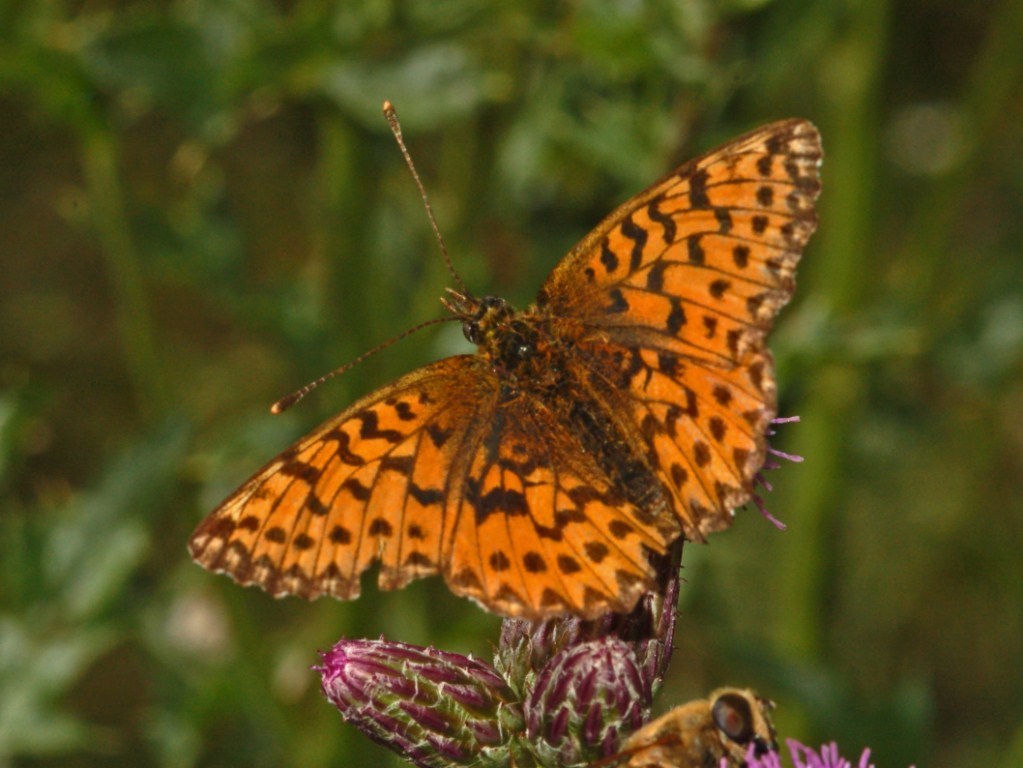
Titania's fritillary is a small butterfly with orange-brown chequered wings and distinctive triangular markings on the edges. It lives in subalpine meadows across the Palearctic, from central Europe through Siberia to the Altai, and the adults are on the wing from June to August. The caterpillars feed on a range of plants including violets, bilberry, Bistorta, meadowsweet and Asian globeflower.
Source: Wikipedia
How to recognize it
The adult has a chequered orange-brown upperside with a marginal row of triangles and dots, while the underside shows brown pearly spots and triangular edge markings on the hindwings.
Source: Wikipedia
Size
Forewing length measures between 21 and 23 mm.
Source: Wikipedia
Where it lives
It flies in subalpine meadows, depending on the location.
Source: Wikipedia
Life cycle
Adults are on the wing from June to August, varying with location.
Source: Wikipedia
When you see it
Flight period is June through August, depending on where they live.
Source: Wikipedia
Lookalikes
A. amathusia (also called diana, titania, dia major) resembles large specimens of euphrosyne on the upperside. The eastern European form bivina is smaller, paler, with thinner lilac markings and a more uniformly yellow median band on the hindwing underside.
Source: Wikipedia
Where it is found in the US
Recorded in 9 of 51 states and DC. Most records: Colorado, Montana, Utah, New Hampshire, New Mexico, Minnesota, Alaska, Wyoming.
Darker = more records. Counts are museum and citizen-science records, not population size.
Source: GBIF
Months it is reported in the US
Source: GBIF
Questions people ask
When are Titania's fritillary butterflies active?
Adults fly from June to August, depending on the location.
Source: Wikipedia
What do the caterpillars eat?
They feed on Viola, bilberry (Vaccinium uliginosum), Bistorta major, meadowsweet (Filipendula ulmaria) and Asian globeflower (Trollius asiaticus).
Source: Wikipedia
Same family (Nymphalidae)




Sources
- Wikipedia: https://en.wikipedia.org/wiki/Boloria_titania
Look it up elsewhere: GBIF · iNaturalist · BugGuide · ITIS · Wikipedia
Text written 2026-10-27 from the sources above and checked sentence by sentence against them. Data fetched 2026-10-27.