 Bug FAQ
Tiger Bee Fly
Xenox tigrinus · Order: Diptera · Family: Bombyliidae

Tiger bee flies are about 12 to 19 mm long, black with transparent wings marked in bold black patterns, and are found in eastern North America. Adults feed on flower nectar while their larvae parasitize carpenter bee brood, but they do not bite, sting, or damage structures.
Source: Wikipedia
How to recognize it
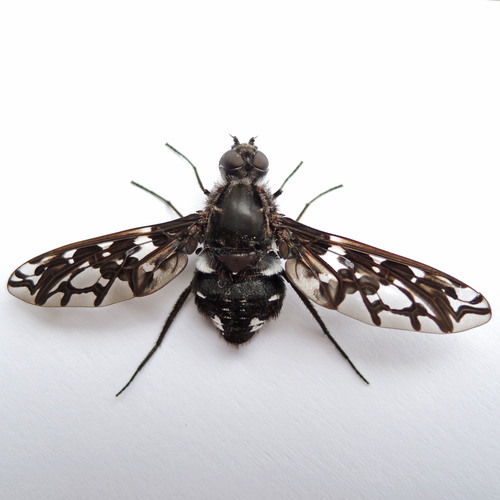
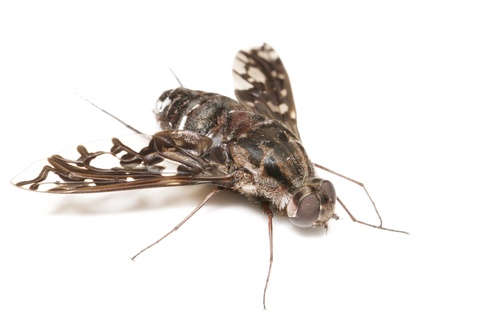
The fly has a mostly black body and clear wings with irregular black spots that set it apart from other bee flies.
Source: Wikipedia
Size
Adults measure roughly 12 to 19 mm in body length, not counting wings, antennae, or legs.
Source: Wikipedia
Is it a pest in the house?
They do not chew wood or cause any damage to structures; they appear only where carpenter bees are already nesting.
Source: Wikipedia
Does it bite or sting?
Tiger bee flies neither bite nor sting humans, and they lack a stinger.
Source: Wikipedia
What it eats
Adults visit flowers for nectar, while the larvae act as parasitoids of carpenter bee larvae.
Source: Wikipedia
Life cycle
Females lay eggs on or near the entrance of carpenter bee nests in wood, and the hatched larvae enter the nest to feed on the bee brood.
Source: Wikipedia
Where it comes from
The species is native to the eastern United States and southern Ontario.
Source: Wikipedia
Lookalikes
Because of their size, black coloration, and hovering flight, they can be mistaken for large bees.
Source: Wikipedia
Where it is found in the US
Recorded in 35 of 51 states and DC. Most records: Pennsylvania, New York, Ohio, Virginia, North Carolina, Maryland, Massachusetts, Michigan.
Darker = more records. Counts are museum and citizen-science records, not population size.
Source: GBIF
Status: native in North America; native in Canada; native in United States. Source: iNaturalist
Months it is reported in the US
Source: GBIF
More photos
Questions people ask
Do tiger bee flies bite or sting?
No, they do not bite or sting and they have no stinger.
Source: Wikipedia
Do they damage my house or wood?
No, they do not chew wood or cause structural damage; they are only present where carpenter bees nest.
Source: Wikipedia
Same family (Bombyliidae)


Sources
- Wikipedia: https://en.wikipedia.org/wiki/Tiger_bee_fly
Look it up elsewhere: GBIF · iNaturalist · BugGuide · ITIS · Wikipedia
Text written 2026-10-22 from the sources above and checked sentence by sentence against them. Data fetched 2026-10-22.