 Bug FAQ
Black Banded Bee Fly
Hemipenthes morio · Order: Diptera · Family: Bombyliidae
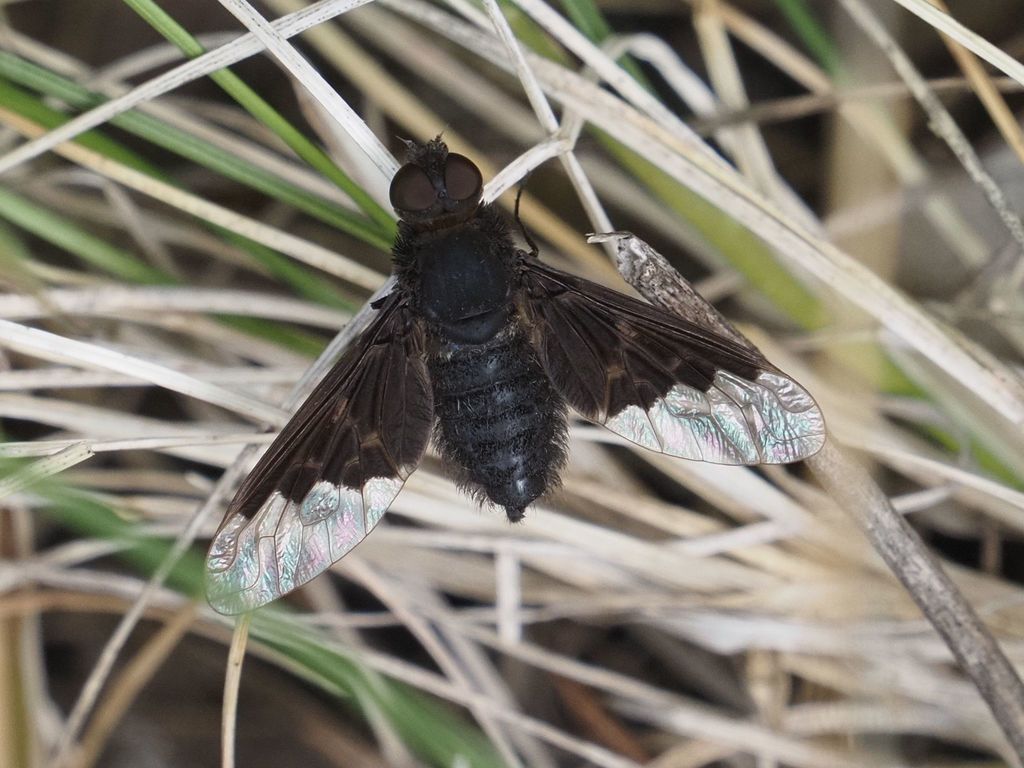
The Black Banded Bee Fly is a small, dark-brown, hairy insect with distinctive wing patterns of light near the tip and dark near the leading edge, separated by a zig-zag line. Adults are seen from May to August visiting a variety of flowers for nectar and pollen, while the larvae live as hyperparasites inside other insect larvae.
Source: Wikipedia
How to recognize it
Wings show a light area near the apex and a dark area near the costal margin, divided by a zig-zag line.
Source: Wikipedia
Size
Adults measure 7 to 10 mm in length with a wingspan of 5 to 15 mm.
Source: Wikipedia
What it eats
Adults feed on flower nectar and pollen; larvae are hyperparasites of fly and wasp larvae that themselves parasitise moth caterpillars.
Source: Wikipedia
Life cycle
Larvae develop as hyperparasites inside other insect larvae, especially flies (Tachinidae) and wasps (Ichneumonidae) that attack noctuid moth caterpillars.
Source: Wikipedia
When you see it
Active adults are most common between May and August.
Source: Wikipedia
Where it comes from
Common throughout most of Europe, the eastern Palearctic region, and the Near East.
Source: Wikipedia
Lookalikes
Very similar to Hemipenthes morioides, a North American species once considered the same.
Source: Wikipedia
Where it is found in the US
Recorded in 4 of 51 states and DC. Most records: Montana, California, South Dakota, Kansas.
Darker = more records. Counts are museum and citizen-science records, not population size.
Source: GBIF
Months it is reported in the US
Source: GBIF
More photos

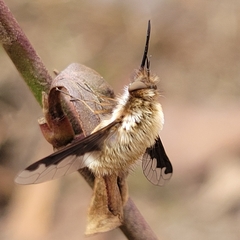
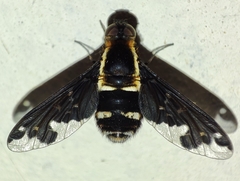
Same family (Bombyliidae)



Sources
- Wikipedia: https://en.wikipedia.org/wiki/Hemipenthes_morio
Look it up elsewhere: GBIF · iNaturalist · BugGuide · ITIS · Wikipedia
Text written 2026-10-22 from the sources above and checked sentence by sentence against them. Data fetched 2026-10-22.