 Bug FAQ
Thorax porcellana
Thorax porcellana · Order: Blattodea · Family: Blaberidae

Both males and females have fully developed wings, but only males fly and only for short distances. The species lives in Sri Lanka and India. Nymphs stay on the mother’s back for about seven weeks, drinking a pinkish fluid from her abdomen and feeding on her haemolymph.
Source: Wikipedia
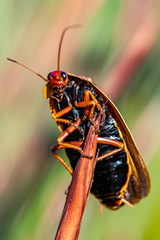
How to recognize it
Both sexes have fully winged bodies.
Source: Wikipedia
Size
Males can fly, but only briefly; females never fly.
Source: Wikipedia
Where it lives
It is an epilamprid cockroach found in Sri Lanka and India.
Source: Wikipedia
What it eats
Nymphs drink a pinkish liquid secreted between the mother’s abdominal tergites and pierce her cuticle to feed on her haemolymph.
Source: Wikipedia
Life cycle
The ovoviviparous female carries 30-40 first-instar nymphs under her domed forewings for about seven weeks.
Source: Wikipedia
Where it comes from
Its native range includes Sri Lanka and India.
Source: Wikipedia
Lookalikes
It has been synonymized as Paraphoraspis notata.
Source: Wikipedia
More photos


Questions people ask
Do males and females both have wings?
Yes, both sexes are fully winged, but only males fly and only for short trips.
Source: Wikipedia
What do the young feed on?
They drink a pinkish fluid from between the mother’s abdominal tergites and pierce her cuticle to suck her haemolymph.
Source: Wikipedia
How many nymphs does a mother carry and for how long?
A mother carries about 30-40 nymphs for roughly seven weeks under her forewings.
Source: Wikipedia
Same family (Blaberidae)




Sources
- Wikipedia: https://en.wikipedia.org/wiki/Thorax_porcellana
Look it up elsewhere: GBIF · iNaturalist · BugGuide · Wikipedia
Text written 2026-10-23 from the sources above and checked sentence by sentence against them. Data fetched 2026-10-23.