 Bug FAQ
Cape Mountain Cockroach
Aptera fusca · Order: Blattodea · Family: Blaberidae
Also called: Table Mountain Cockroach
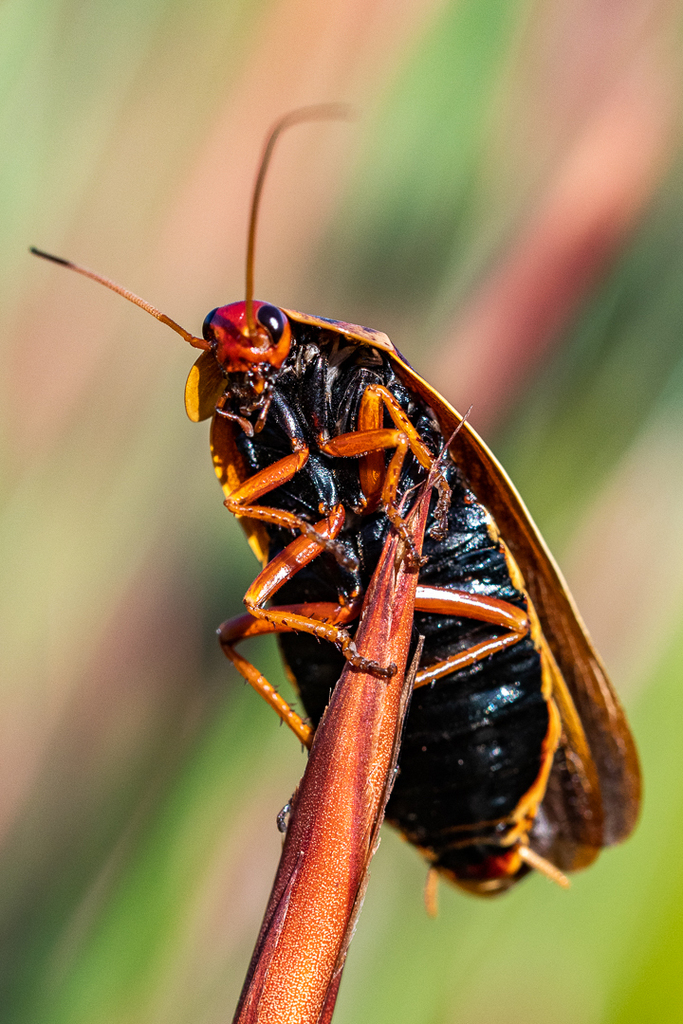
Adult females are 30 to 40 mm long and males about 29 mm, with a stout body, reddish head, brown-black segments and yellow margins. They live on low vegetation in open fynbos areas of South Africa’s Western Cape, are nocturnal herbivores, and give birth to 18 to 24 live young that are cared for briefly. Family groups appear in late summer and autumn, consisting of a wingless female, several males and a brood of black nymphs hidden in cracks.
Source: Wikipedia
How to recognize it
The cockroach has a stout build, reddish head, brown-black body segments with bright yellow edges, heavily spined femora, and hind tibiae with two broad ridges and two rows of spurs.
Source: Wikipedia
Size
Females measure 30 to 40 mm (1.2 to 1.6 in) in length. Males are slightly smaller, about 29 mm (1.1 in) long.
Source: Wikipedia
Where it lives
It is a large cockroach common on low vegetation in open fynbos areas of the Western Cape, South Africa.
Source: Wikipedia
What it eats
It is nocturnal and feeds on plant material.
Source: Wikipedia
Where it comes from
Its native range is the Western Cape region of South Africa.
Source: Wikipedia
More photos


Questions people ask
What does the Cape Mountain Cockroach eat?
It is a nocturnal herbivore that feeds on plant material.
Source: Wikipedia
When can I see family groups of this cockroach?
Family groups appear in late summer and autumn.
Source: Wikipedia
Same family (Blaberidae)




Sources
- Wikipedia: https://en.wikipedia.org/wiki/Aptera_fusca
Look it up elsewhere: GBIF · iNaturalist · BugGuide · Wikipedia
Text written 2026-10-23 from the sources above and checked sentence by sentence against them. Data fetched 2026-10-22.