 Bug FAQ
Texas Buck Moth
Hemileuca peigleri · Order: Lepidoptera · Family: Saturniidae
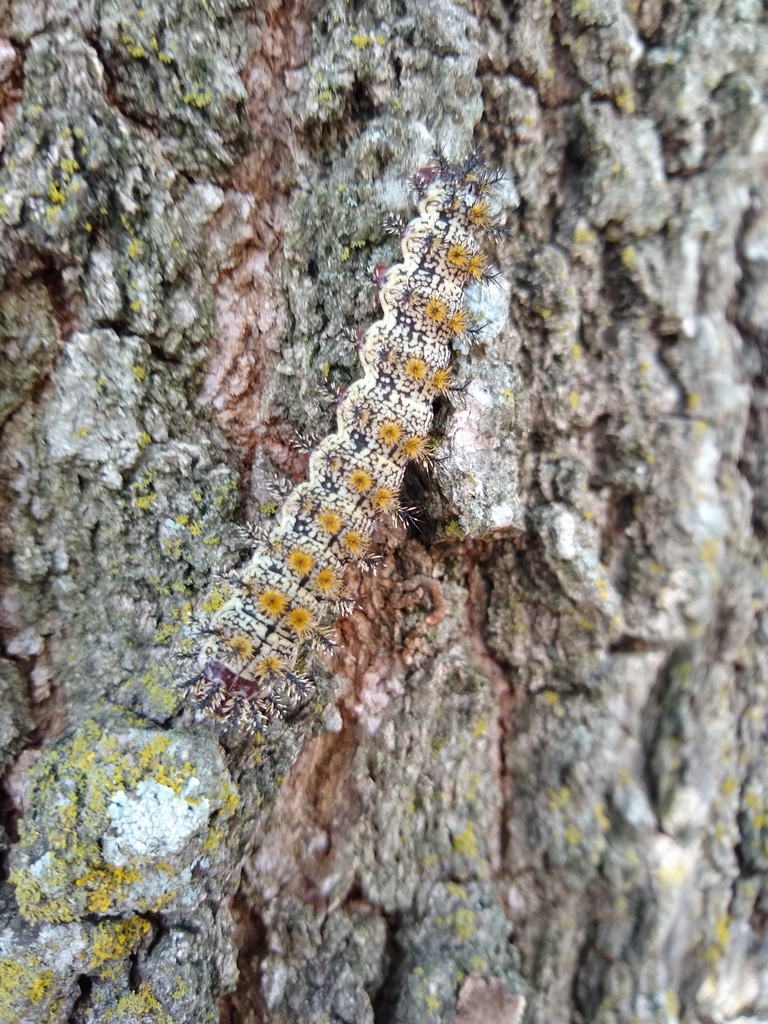
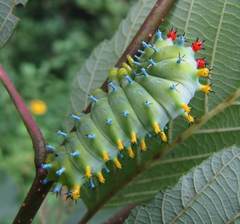
The Texas buck moth has a wingspan of about 6 to 8 cm. It lives on oak-covered hills in central Texas and its caterpillars feed on several oak species. Adult moths do not feed.
Source: Wikipedia
How to recognize it
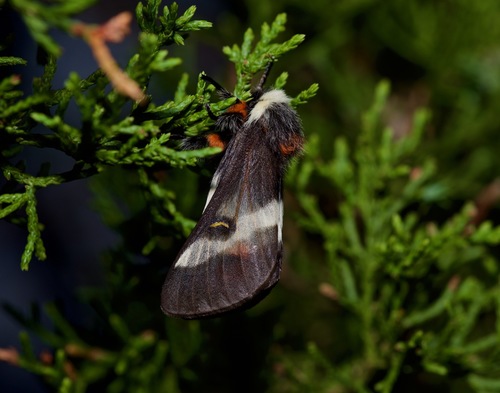
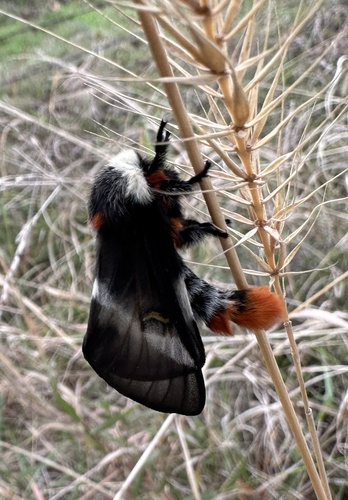
Males have a black abdomen with a red tip; females have a solid black abdomen. Each wing shows a wide white band and a small eyespot.
Source: Wikipedia
Size
Wingspan ranges from 5.8 cm to 8.2 cm.
Source: Wikipedia
Where it lives
Found on hills covered with oak trees.
Source: Wikipedia
What it eats
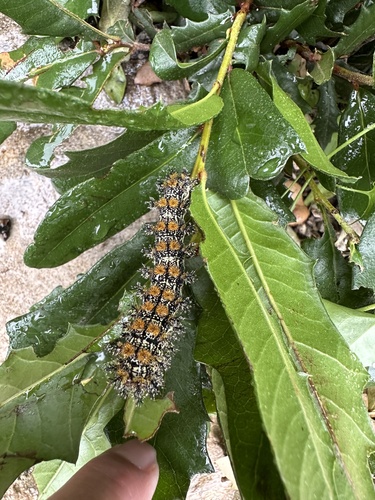
Caterpillars feed on Texas live oak, Havard's oak, Shumard's oak, and Nuttall oak.
Source: Wikipedia
Life cycle
Adult moths do not feed.
Source: Wikipedia
Where it comes from
Its range is in central Texas.
Source: Wikipedia
Where it is found in the US
Recorded in 1 of 51 states and DC. Most records: Texas.
Darker = more records. Counts are museum and citizen-science records, not population size.
Source: GBIF
Months it is reported in the US
Source: GBIF
More photos
Questions people ask
What do Texas buck moth caterpillars eat?
They feed on several oak species, including Texas live oak, Havard's oak, Shumard's oak, and Nuttall oak.
Source: Wikipedia
Same family (Saturniidae)


Sources
- Wikipedia: https://en.wikipedia.org/wiki/Hemileuca_peigleri
Look it up elsewhere: GBIF · iNaturalist · BugGuide · Wikipedia
Text written 2026-10-24 from the sources above and checked sentence by sentence against them. Data fetched 2026-10-24.