 Bug FAQ
Io Moth
Automeris io · Order: Lepidoptera · Family: Saturniidae
Source: Wikipedia, hgic.clemson.edu
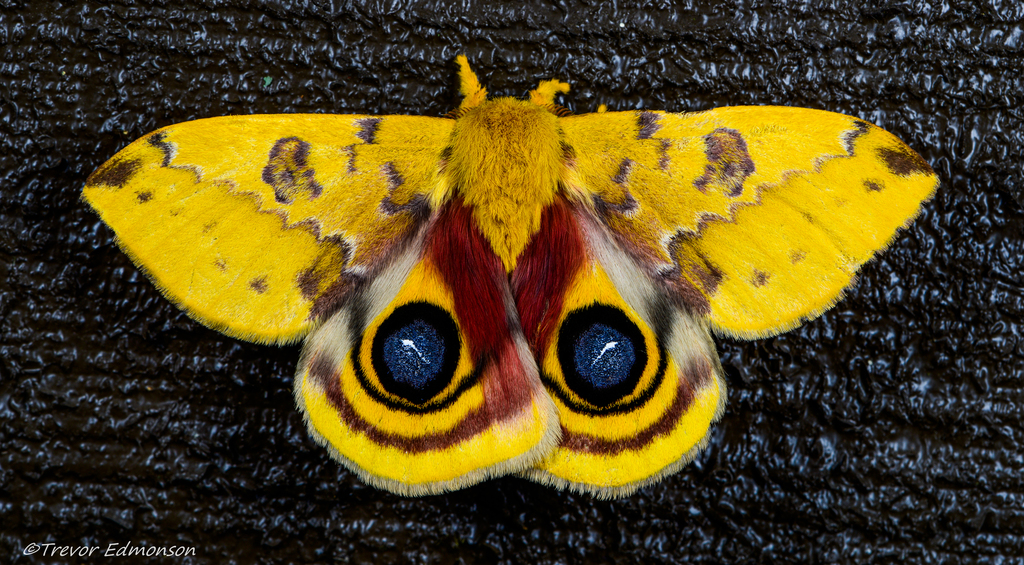
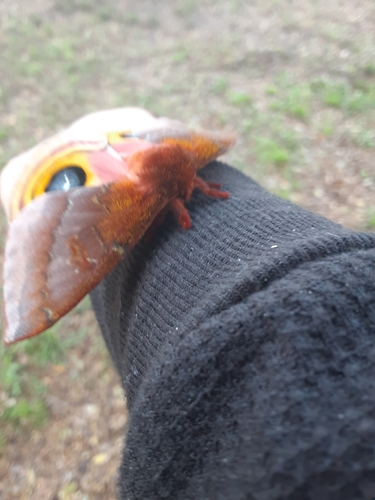
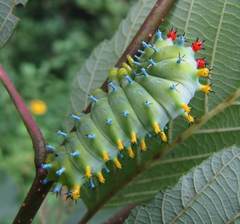
Adult Io moths have a wingspan of about 2.5 to 3.5 inches and show bright yellow or reddish-brown forewings with a single large eye-spot on each hindwing. The caterpillars are spiky, feed on many hardwood trees, and their hairs can cause a painful sting and skin irritation.
Source: Wikipedia, hgic.clemson.edu
How to recognize it
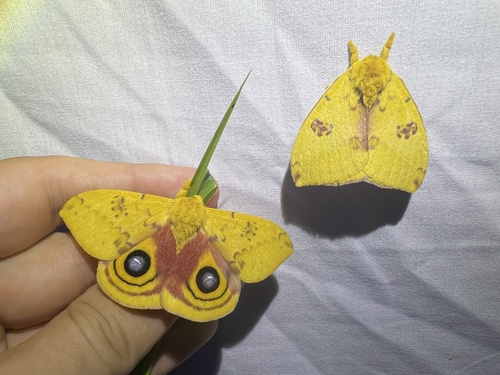
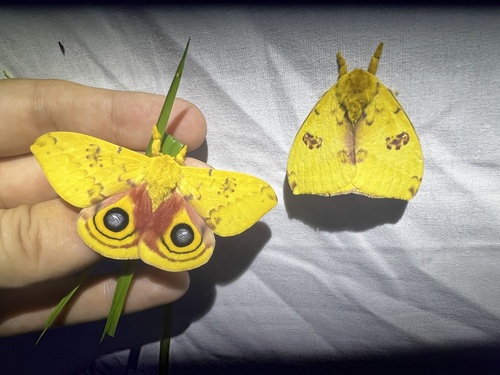
Males are bright yellow on the forewings, body and legs, while females are reddish-brown to purple in those areas. Both sexes have one large dark eye-spot with a white center on each hindwing.
Source: Wikipedia, hgic.clemson.edu
Size
Fully grown adults have a wingspan ranging from 63 to 88 mm (about 2.5 to 3.5 inches).
Source: Wikipedia
Does it bite or sting?
The spines on the caterpillars release a very painful venom when touched. Contact with the spines can cause acute dermatitis (erucism) but is not life-threatening. For more details see HGIC 2482 on stinging caterpillars.
Source: Wikipedia, hgic.clemson.edu
How to get rid of it
Avoid handling the caterpillars unless necessary, as their hairs can sting.
Source: hgic.clemson.edu
Where it lives
The species occurs across much of the United States from the northern plains to the Gulf Coast and into southeastern Canada.
Source: Wikipedia
What it eats
Caterpillars are herbivorous and feed together on a variety of hardwood trees such as oak, birch, hickory and dogwood.
Source: Wikipedia, hgic.clemson.edu
Life cycle
The larvae pass through five instars before pupating. Adults emerge from cocoons in late morning or early afternoon, typically in June and July.
Source: Wikipedia
When you see it
Adult moths are active at night, especially during the peak hours of darkness.
Source: Wikipedia
Where it comes from
It is native to the United States and Canada, found from Montana and the Dakotas eastward to Florida and up into southern Canadian provinces.
Source: Wikipedia
Where it is found in the US
Recorded in 44 of 51 states and DC. Most records: Florida, Texas, Ohio, Louisiana, Pennsylvania, New York, Virginia, Massachusetts.
Darker = more records. Counts are museum and citizen-science records, not population size.
Source: GBIF
Status: native in North America; native in Canada; native in United States. Source: iNaturalist
Months it is reported in the US
Source: GBIF
More photos
Questions people ask
How can I avoid being stung by Io moth caterpillars?
Do not touch the caterpillars; if you must move them wear gloves and use tools to avoid skin contact.
Source: Wikipedia, hgic.clemson.edu
What trees do Io moth caterpillars eat?
They feed on hardwoods such as oak, birch, hickory and dogwood.
Source: hgic.clemson.edu
When are adult Io moths active?
Adults are nocturnal and fly during the night, especially in June and July.
Source: Wikipedia
Same family (Saturniidae)

Sources
- Wikipedia: https://en.wikipedia.org/wiki/Automeris_io
- hgic.clemson.edu: https://hgic.clemson.edu/what-is-it-wednesday-io-moth-caterpillars/
Look it up elsewhere: GBIF · iNaturalist · BugGuide · ITIS · Wikipedia
Text written 2026-10-23 from the sources above and checked sentence by sentence against them. Data fetched 2026-10-23.