 Bug FAQ
Tawny Crescent
Phyciodes batesii · Order: Lepidoptera · Family: Nymphalidae

The tawny crescent butterfly has a wingspan of about 25 to 38 mm and flies once a year from May to July. It lives in North America and feeds on the plant Symphyotrichum undulatum.
Source: Wikipedia
How to recognize it
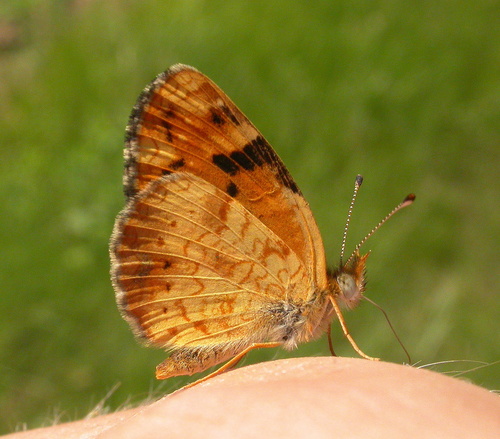
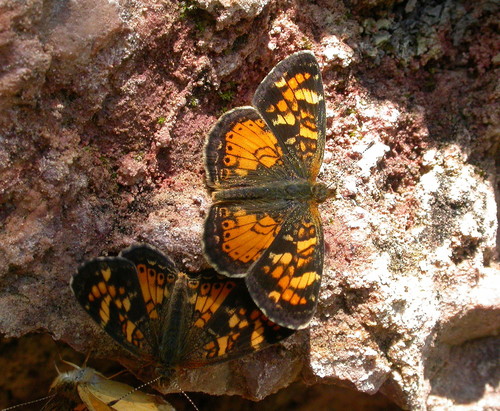
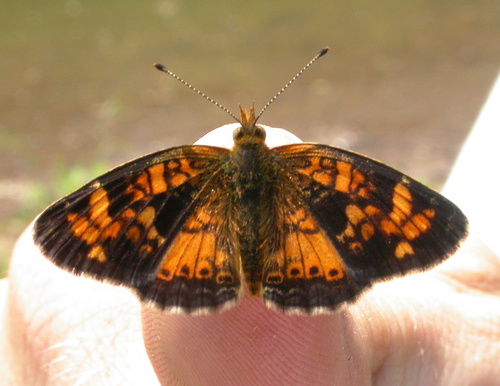
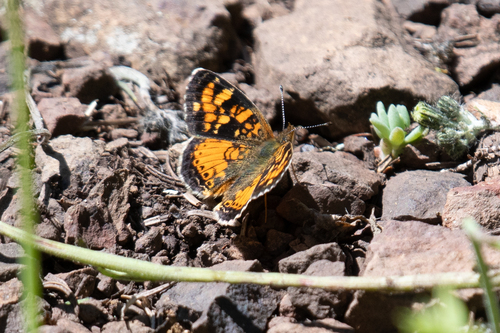
Females have dots on the black submarginal band. Both males and females have black and white antenna knobs.
Source: Wikipedia
Size
The wingspan ranges from 25 to 38 mm.
Source: Wikipedia
What it eats
Adults feed on Symphyotrichum undulatum.
Source: Wikipedia
Life cycle
Adults are on the wing once a year between May and July. Fourth-instar caterpillars spend the winter in hibernation.
Source: Wikipedia
When you see it
Adults fly once a year from May through July. In Michigan there can be a partial second brood.
Source: Wikipedia
Where it comes from
Its native range is North America.
Source: Wikipedia
Lookalikes
It can be confused with the northern crescent (Phyciodes cocyta). It can also be mistaken for the pearl crescent (Phyciodes tharos).
Source: Wikipedia
Where it is found in the US
Recorded in 23 of 51 states and DC. Most records: Michigan, Nebraska, Colorado, South Dakota, Wyoming, New York, Minnesota, North Carolina.
Darker = more records. Counts are museum and citizen-science records, not population size.
Source: GBIF
Status: native in North America; native in Canada; native in United States. Source: iNaturalist
Months it is reported in the US
Source: GBIF
More photos
Questions people ask
When can I see the tawny crescent?
Adults are active from May to July, with a possible second partial brood in Michigan.
Source: Wikipedia
Same family (Nymphalidae)




Sources
- Wikipedia: https://en.wikipedia.org/wiki/Phyciodes_batesii
Look it up elsewhere: GBIF · iNaturalist · BugGuide · ITIS · Wikipedia
Text written 2026-10-24 from the sources above and checked sentence by sentence against them. Data fetched 2026-10-24.