 Bug FAQ
Tawny Coster
Acraea terpsicore · Order: Lepidoptera · Family: Nymphalidae
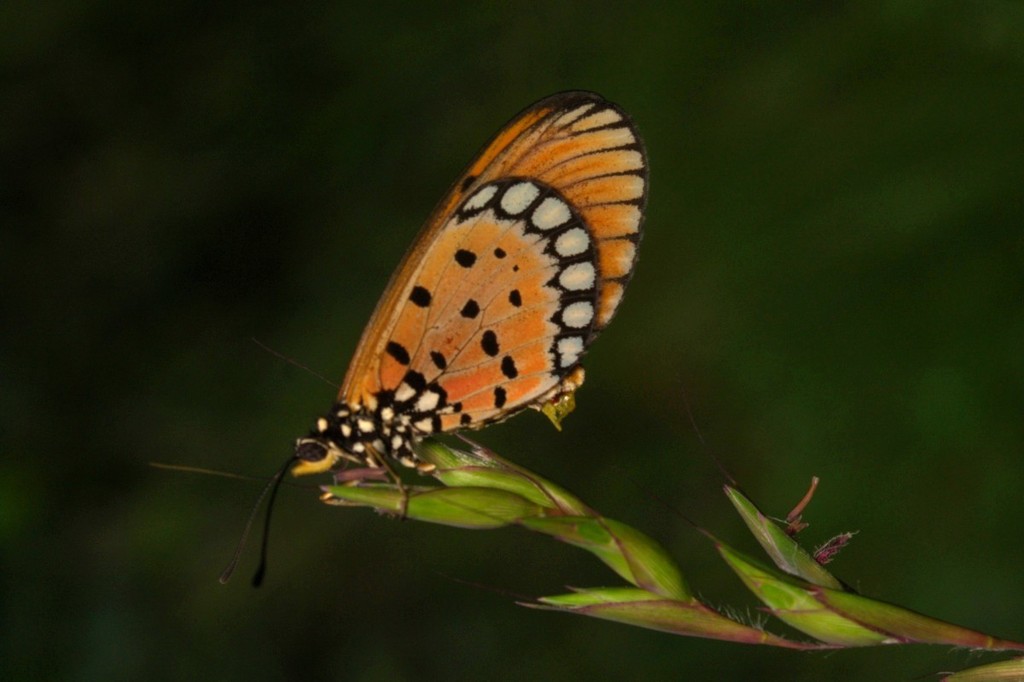
The Tawny Coster has a wingspan of about 53 to 64 mm and the caterpillar grows to roughly 21 mm long. It lives in grassland and scrub, staying low to the ground and often resting a meter above the soil. It is found across South and Southeast Asia and has recently been recorded in Australia.
Source: Wikipedia
How to recognize it
The upper side of the wings is tawny with black markings, including a transverse spot on the forewing and a series of black spots near the wing edges.
Source: Wikipedia
Size
Adults have a wingspan between 53 and 64 mm. Fully grown caterpillars are about 21 mm long.
Source: Wikipedia
Does it bite or sting?
When threatened, the butterfly may play dead and release a noxious yellowish fluid from leg joints. Its tough exoskeleton can survive pecks from birds or bites from lizards.
Source: Wikipedia
Where it lives
It is common in grassland and scrub habitats. The butterfly stays within about 3 m of the ground and rests on vegetation roughly a meter above the ground.
Source: Wikipedia
What it eats
Caterpillars feed on Loganiaceae and Passiflora species, which contain toxins they sequester. They have also been observed eating Hybanthus enneaspermus in Bengal and Turnera ulmifolia in Maharashtra.
Source: Wikipedia
Life cycle
Eggs are laid in clusters of 20 to 100, are yellow, slightly elongated, and have shallow transverse ribbing.
Source: Wikipedia
Lookalikes
It was once confused with the African species Acraea eponina and is one of only two Indian members of the mainly African tribe Acraeini, the other being the yellow coster.
Source: Wikipedia
Questions people ask
Where can I find Tawny Coster butterflies?
They are common in grassland and scrub areas across South and Southeast Asia and have recently been recorded in Australia.
Source: Wikipedia
Same family (Nymphalidae)






Sources
- Wikipedia: https://en.wikipedia.org/wiki/Acraea_terpsicore
Look it up elsewhere: GBIF · iNaturalist · BugGuide · Wikipedia
Text written 2026-10-22 from the sources above and checked sentence by sentence against them. Data fetched 2026-10-22.