 Bug FAQ
Tailed Jay
Graphium agamemnon · Order: Lepidoptera · Family: Papilionidae
Also called: Green-spotted Triangle, Green-spotted Triangle Butterfly

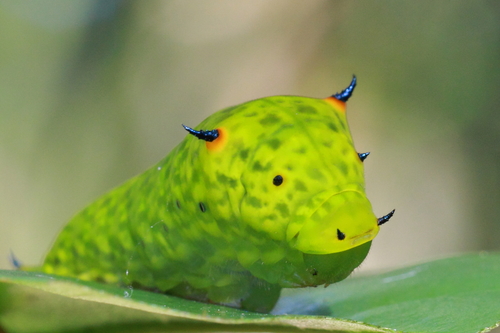
The male Tailed Jay has black upper wings with distinctive green spots and bars, plus three transverse green markings on the hindwing, the upper ones white. It lives in low-elevation gardens and urban areas where its host trees like Polyalthia longifolia are planted. Its range extends from Nepal and India through Southeast Asia to Australia, and it feeds on many flowering plants and several Annonaceae trees.
Source: Wikipedia
How to recognize it
Males show black uppersides with green spots and bars on the forewing and three transverse green markings on the hindwing, the uppermost white.
Source: Wikipedia
Where it lives
Common in gardens and urban areas at low elevations, especially where Polyalthia longifolia is used as an ornamental tree.
Source: Wikipedia
What it eats
Males often nectar from Lantana, Ixora, Mussaenda, and Poinsettia flowers. Larvae feed on several Annonaceae species and other trees such as Polyalthia, Michelia, Cinnamomum, and Artabotrys.
Source: Wikipedia
Life cycle
Development from egg to adult takes about 33 to 36 days. The species can produce seven or eight generations each year.
Source: Wikipedia
When you see it
Adults are active year-round, with numbers rising after monsoon rains when host plants are abundant.
Source: Wikipedia
Where it comes from
Native and non-threatened across Nepal, India, Sri Lanka, Southeast Asia, and Australia.
Source: Wikipedia
Lookalikes
The Andaman/Nicobar race decoratus looks similar but has smaller green spots, especially in the forewing discal series.
Source: Wikipedia
More photos
Questions people ask
Where can I see a Tailed Jay?
Look for them in low-elevation gardens and urban areas where Polyalthia longifolia is planted.
Source: Wikipedia
How many generations do they have per year?
They can have seven or eight broods annually.
Source: Wikipedia
Same family (Papilionidae)
Sources
- Wikipedia: https://en.wikipedia.org/wiki/Graphium_agamemnon
Look it up elsewhere: GBIF · iNaturalist · BugGuide · Wikipedia
Text written 2026-10-22 from the sources above and checked sentence by sentence against them. Data fetched 2026-10-22.