 Bug FAQ
Striped Blue Crow
Euploea mulciber · Order: Lepidoptera · Family: Nymphalidae
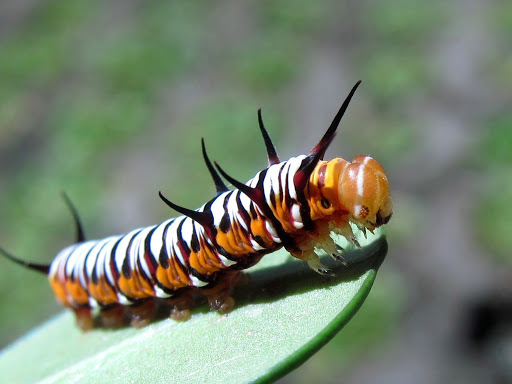
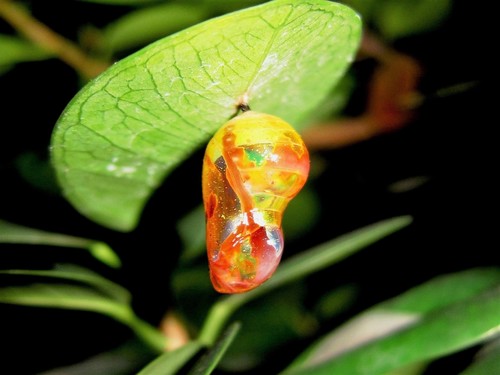
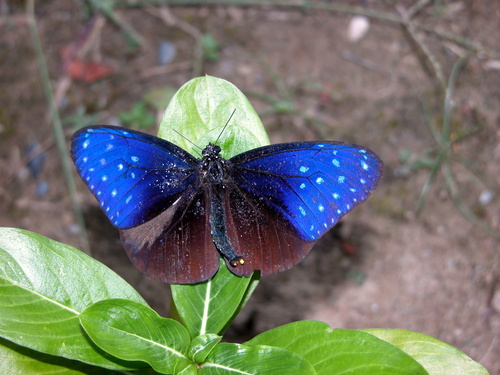
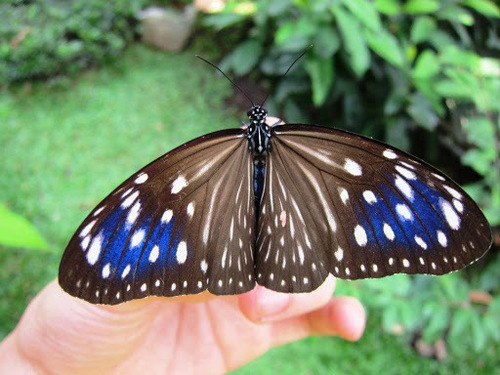
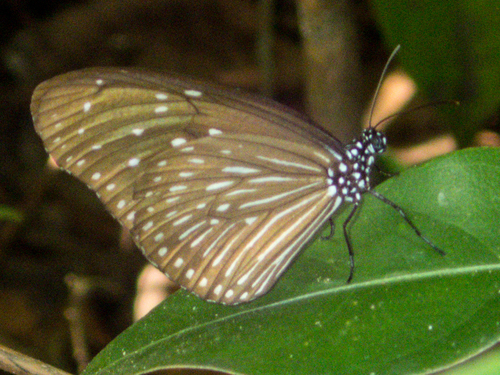
Male striped blue crows have dark brown uppersides with a glossy brilliant blue sheen and several white spots, plus a largely unmarked hindwing with a light-brown patch of hair-like scales on the outer third. Their caterpillars feed on a variety of plants such as oleander, figs, Aristolochia and other vines, and the pupae are short, thick and metallic golden-brown.
Source: Wikipedia
What it eats
The larvae eat plants including Nerium (oleander), Ichnocarpus species, Toxocarpus wightianus, Aristolochia, Argyreia penangiana, and several Ficus species.
Source: Wikipedia
Life cycle
The pupa is short and thick in the middle, with a concave thorax behind, convex dorsal abdominal segments, and a metallic golden-brown colour with a darker brown stripe at the front.
Source: Wikipedia
Lookalikes
The striped blue crow (Euploea mulciber) is a butterfly from India and Southeast Asia belonging to the danaid group of brush-footed butterflies.
Source: Wikipedia
More photos
Questions people ask
What do the caterpillars of the striped blue crow look like?
They are cylindrical and have four pairs of long fleshy filaments with pink bases and black tips; three pairs are on the front segments and one pair is on the 12th segment.
Source: Wikipedia
How does the pupa of the striped blue crow appear?
The pupa is short and thick in the middle, with a concave thorax behind, convex dorsal abdominal segments, and a metallic golden-brown colour with a darker brown stripe at the front.
Source: Wikipedia
Same family (Nymphalidae)






Sources
- Wikipedia: https://en.wikipedia.org/wiki/Euploea_mulciber
Look it up elsewhere: GBIF · iNaturalist · BugGuide · Wikipedia
Text written 2026-10-22 from the sources above and checked sentence by sentence against them. Data fetched 2026-10-22.