 Bug FAQ
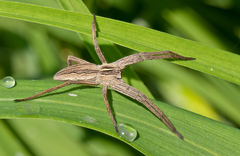
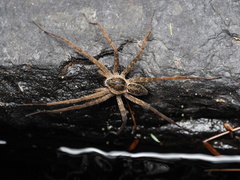
Straight-banded Nursery Web Spider
Pisaurina brevipes · Order: Araneae · Family: Pisauridae

Female Straight-banded Nursery Web Spiders are 11 to 13 mm long and males about 10.8 mm. The species builds bell-shaped nursery webs where it rears its young.
Source: Wikipedia
How to recognize it
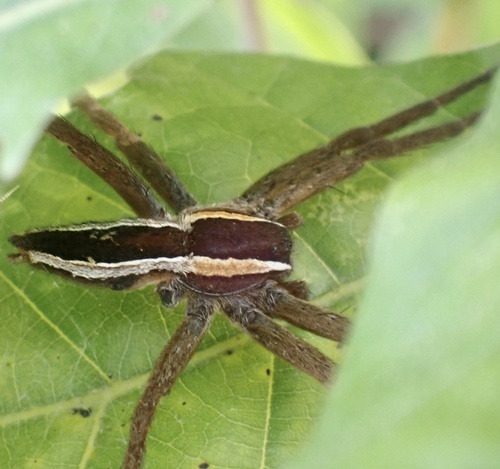
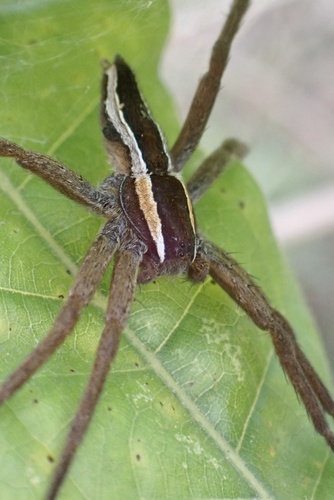
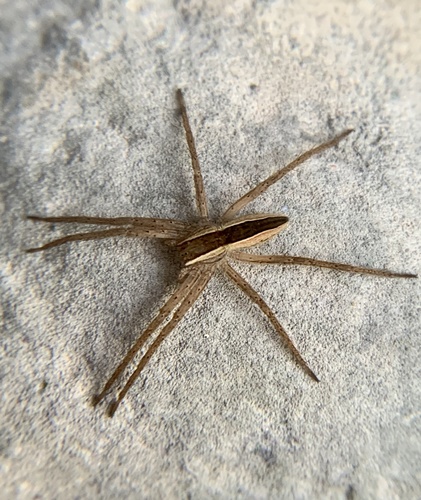
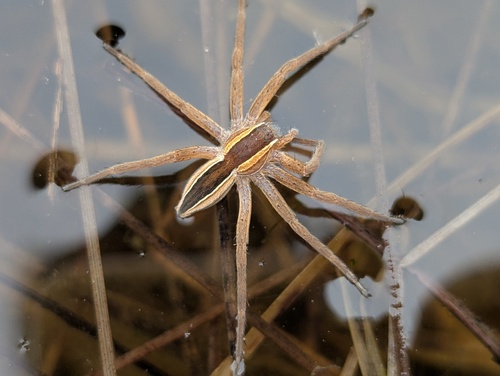
It has relatively shorter legs than the similar Pisaurina mira. The abdominal band has straighter edges compared with P. mira.
Source: Wikipedia
Size
Females measure 11 to 13 mm in body length; males are about 10.8 mm.
Source: Wikipedia
Where it lives
Records show it prefers grasslands, bogs and swamps. It raises its spiderlings in bell-like nursery webs laid out as a sheet.
Source: Wikipedia
Lookalikes
It is difficult to separate from P. mira unless the male pedipalps are examined, because their colour patterns overlap.
Source: Wikipedia
Where it is found in the US
Recorded in 25 of 51 states and DC. Most records: Florida, Illinois, Texas, Ohio, South Carolina, Louisiana, North Carolina, Georgia.
Darker = more records. Counts are museum and citizen-science records, not population size.
Source: GBIF
Status: native in North America; native in Canada. Source: iNaturalist
Months it is reported in the US
Source: GBIF
More photos
Questions people ask
How can I tell this spider apart from the similar Straight-banded Nursery Web Spider?
Check the leg length to this species has shorter legs than Pisaurina mira, and its abdominal band edges are straighter. Male pedipalps also differ if you can examine them.
Source: Wikipedia
Same family (Pisauridae)




Sources
- Wikipedia: https://en.wikipedia.org/wiki/Pisaurina_brevipes
Look it up elsewhere: GBIF · iNaturalist · BugGuide · ITIS · Wikipedia
Text written 2026-10-25 from the sources above and checked sentence by sentence against them. Data fetched 2026-10-25.