 Bug FAQ
Six-spotted Fishing Spider
Dolomedes triton · Order: Araneae · Family: Pisauridae
Also called: Sixspotted Fishing Spider

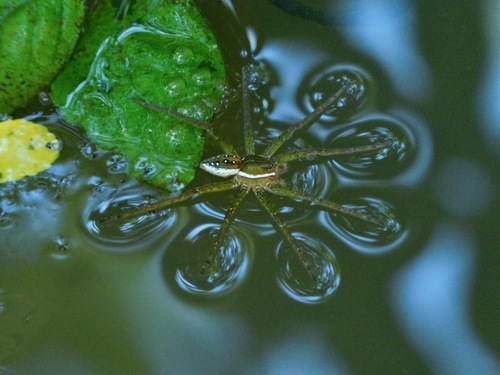
Females reach about 60 mm total length, while males are much smaller, and juveniles look like tiny adults. They live near water in wetlands, ponds, lake edges, and slow streams, often on vegetation or docks. They can catch fish up to five times their size, as well as insects, tadpoles, frogs, and small fish.
Source: Wikipedia
How to recognize it
A pale stripe runs down each side of the cephalothorax, and the abdomen shows many light spots and side lines. From below, six dark spots are visible on the underside of the cephalothorax, giving the spider its name.
Source: Wikipedia
Size
Females are about 60 mm long including legs, with a body length of 15 to 20 mm; males have a body length of 9 to 13 mm. Juveniles resemble adults but are smaller.
Source: Wikipedia
Does it bite or sting?
They detect prey by feeling vibrations on the water surface and by sight.
Source: Wikipedia
Where it lives
They are semi-aquatic and live in wetlands such as ponds, lake shores, and slow-moving streams. You’ll find them on emergent plants, rocks, and structures like boat docks near water.
Source: Wikipedia
What it eats
They can capture fish up to five times their own size, using venom to subdue prey. Their prey includes aquatic insects, surface-dwelling organisms, fallen terrestrial insects, tadpoles, frogs, and small fish.
Source: Wikipedia
Life cycle
Juveniles look like smaller versions of adults and grow by molting several times before reaching maturity.
Source: Wikipedia
When you see it
Eggs are laid between June and September, with occasional production in April. They are active during the day.
Source: Wikipedia
Lookalikes
They resemble Dolomedes striatus but can be told apart by three pairs of dark spots on the sternum and several light spots on the abdomen. Males have a tibial apophysis that extends past the tibia tip and is more rounded at the end.
Source: Wikipedia
Where it is found in the US
Recorded in 49 of 51 states and DC. Most records: Texas, Florida, Ohio, North Carolina, Virginia, Louisiana, Georgia, Maryland.
Darker = more records. Counts are museum and citizen-science records, not population size.
Source: GBIF
Status: native in North America; native in Canada; native in United States. Source: iNaturalist
Months it is reported in the US
Source: GBIF
More photos


Questions people ask
Where might I find this spider around my home?
Look near ponds, lake edges, slow streams, or on docks and plants close to water.
Source: Wikipedia
What do they eat?
They catch fish, tadpoles, frogs, aquatic insects, and any insects that fall into the water.
Source: Wikipedia
Same family (Pisauridae)



Sources
- Wikipedia: https://en.wikipedia.org/wiki/Six-spotted_fishing_spider
Look it up elsewhere: GBIF · iNaturalist · BugGuide · ITIS · Wikipedia
Text written 2026-10-22 from the sources above and checked sentence by sentence against them. Data fetched 2026-10-22.