 Bug FAQ
Spot-winged Glider
Pantala hymenaea · Order: Odonata · Family: Libellulidae
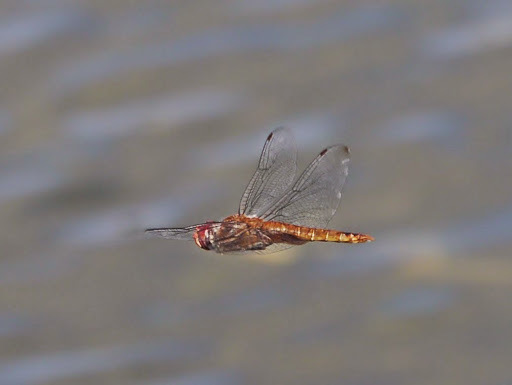
The Spot-winged Glider is a medium-sized, brown dragonfly that migrates long distances and breeds in temporary water bodies. It feeds on mosquitoes as an adult and its nymphs feed openly in the water. It occurs across much of North and South America, moving north in summer and south in fall.
Source: Wikipedia
How to recognize it
The body is brown and females or immature ones have a diagonal white mark on the thorax.
Source: Wikipedia
Size
It measures about 5 cm (2 in) long with a wingspan of roughly 7.5 cm (3 in).
Source: Wikipedia
Where it lives
It is a strong, migratory flier.
Source: Wikipedia
What it eats
Adults mainly eat the mosquito Aedes freeborni at dusk when the insects swarm. Nymphs feed openly in the water.
Source: Wikipedia
Life cycle
In North America, generations migrate northward in summer and southward in fall, but the species’ biology is not well known.
Source: Wikipedia
When you see it
Northward migration occurs in summer and southerly migration in fall.
Source: Wikipedia
Where it comes from
Its range includes six Canadian provinces, 45 U.S. states, 24 Mexican states, the West Indies, and much of Central and South America down to Argentina.
Source: Wikipedia
Where it is found in the US
Recorded in 47 of 51 states and DC. Most records: Texas, California, Ohio, New Jersey, Arizona, New York, Maryland, Oklahoma.
Darker = more records. Counts are museum and citizen-science records, not population size.
Source: GBIF
Status: native in North America; native in Canada; native in United States. Source: iNaturalist
Months it is reported in the US
Source: GBIF
More photos
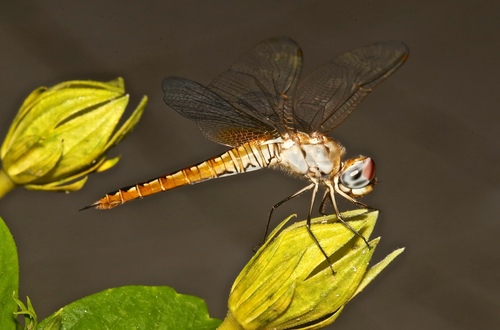
Same family (Libellulidae)
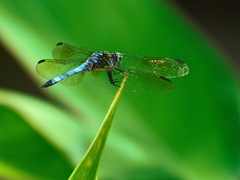
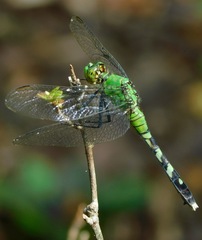
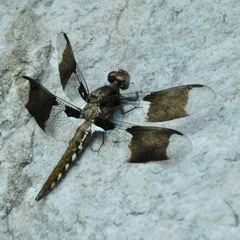

Sources
- Wikipedia: https://en.wikipedia.org/wiki/Pantala_hymenaea
Look it up elsewhere: GBIF · iNaturalist · BugGuide · ITIS · Wikipedia
Text written 2026-10-22 from the sources above and checked sentence by sentence against them. Data fetched 2026-10-22.