 Bug FAQ
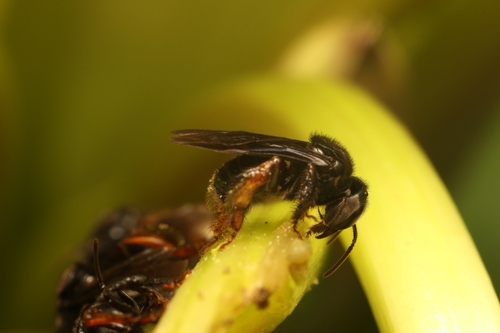
Spiny-legged Stingless bee
Trigona spinipes · Order: Hymenoptera · Family: Apidae
Source: Wikipedia

Trigona spinipes builds mud-resin nests high up on trees or buildings and can grow to full size in about six months, housing thousands to over a hundred thousand workers. The bee is an important pollinator for crops such as onions, but it can become an agricultural pest by chewing leaves and tunnelling into unopened passion-fruit flowers.
Source: Wikipedia
How to recognize it
Its name means “spiny feet” in Latin. Its nests are built higher than those of many other Trigona species.
Source: Wikipedia
Size
A colony can contain from 5,000 up to more than 100,000 workers. Nests reach full physical size within about six months. The nests are perennial, lasting year after year.
Source: Wikipedia
Does it bite or sting?
It cannot sting and its bite is weak. When threatened it may wrap itself around hair and buzz loudly, and can enter human nose or ear openings.
Source: Wikipedia
Where it lives
It builds nests on trees, buildings, or other human structures using mud, resin, wax, debris and even dung.
Source: Wikipedia
What it eats
It pollinates crops such as onions and follows odor trails that can extend several hundred metres to food sources.
Source: Wikipedia
Life cycle
Colonies may contain from a few thousand to over a hundred thousand workers and grow to full size in about half a year. Nests persist year after year.
Source: Wikipedia
Lookalikes
It is part of the tribe Meliponini, the stingless bees.
Source: Wikipedia
More photos
Questions people ask
Is Trigona spinipes a crop pest?
Yes, it damages passion-fruit leaves and flowers while collecting nest material.
Source: Wikipedia
How does it defend itself?
It may entangle itself in a person’s hair and buzz loudly, and can enter nose or ear openings when attacking.
Source: Wikipedia
Where does it build its nest?
It builds nests high up on trees, buildings or other structures using mud, resin, wax and debris.
Source: Wikipedia
Same family (Apidae)


Sources
- Wikipedia: https://en.wikipedia.org/wiki/Trigona_spinipes
Look it up elsewhere: GBIF · iNaturalist · BugGuide · ITIS · Wikipedia
Text written 2026-10-22 from the sources above and checked sentence by sentence against them. Data fetched 2026-10-22.