 Bug FAQ
Southern Plains Bumble Bee
Bombus fraternus · Order: Hymenoptera · Family: Apidae

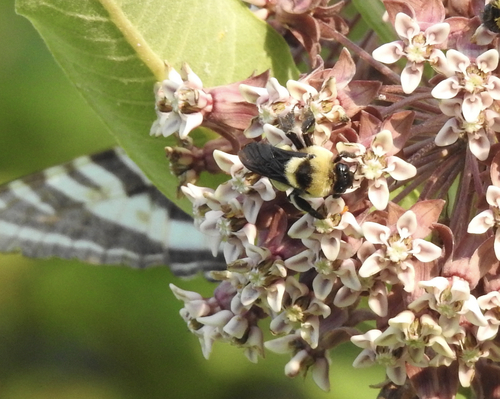
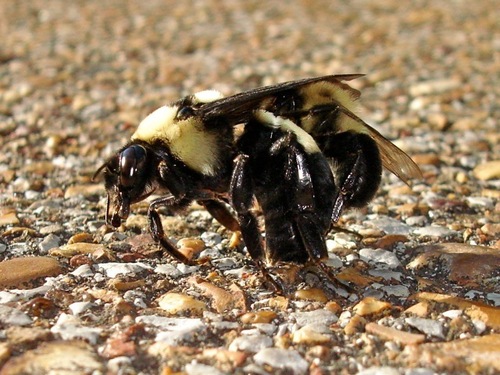
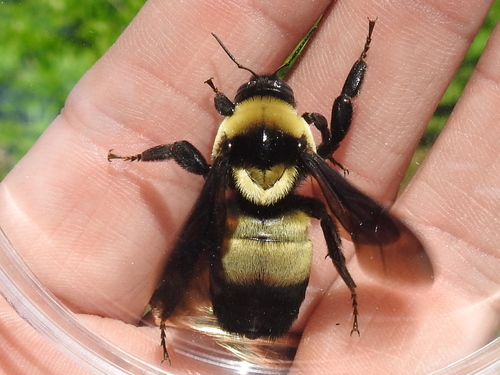
The Southern Plains bumble bee is a large, mostly black bee with yellow bands and distinctive flattened black hairs on the third abdominal segment. Queens are about 25-27 mm long, workers 15-19 mm, and males 22-25 mm. It lives in open prairies, meadows and grasslands across the southeastern coastal plain and the Great Plains, and can also be found in agricultural and urban areas.
Source: Wikipedia
How to recognize it
The bee is mostly black with yellow bands on the thorax and abdomen. Females have short yellow and black hairs and flattened black hairs on the third abdominal segment.
Source: Wikipedia
Size
Queens measure about 25-27 mm (0.97-1.07 in). Workers are 15-19 mm (0.56-0.75 in) long. Males are 22-25 mm (0.85-1.00 in) long.
Source: Wikipedia
Where it lives
Also occurs in intact prairie, farmland, and urbanized habitats.
Source: Wikipedia
What it eats
A generalist forager that visits flowers from at least 20 plant families.
Source: Wikipedia
Life cycle
Nests are built underground. Mated females need a place to hibernate over winter after mating.
Source: Wikipedia
When you see it
Historically uncommon and now estimated at less than 15 % of its former numbers. No records of this species exist from Canada.
Source: Wikipedia
Where it is found in the US
Recorded in 33 of 51 states and DC. Most records: Kansas, Nebraska, Texas, South Carolina, Mississippi, Georgia, Missouri, Colorado.
Darker = more records. Counts are museum and citizen-science records, not population size.
Source: GBIF
Status: native in North America; native in United States. Source: iNaturalist
Months it is reported in the US
Source: GBIF
More photos

Questions people ask
Where can I find this bee?
Look in open prairies, meadows, grasslands, farms or urban green spaces across the southeastern coastal plain and the Great Plains.
Source: Wikipedia
Same family (Apidae)


Sources
- Wikipedia: https://en.wikipedia.org/wiki/Bombus_fraternus
Look it up elsewhere: GBIF · iNaturalist · BugGuide · ITIS · Wikipedia
Text written 2026-10-22 from the sources above and checked sentence by sentence against them. Data fetched 2026-10-22.