 Bug FAQ
Southern Masked Chafer
Cyclocephala lurida · Order: Coleoptera · Family: Scarabaeidae
Source: Wikipedia
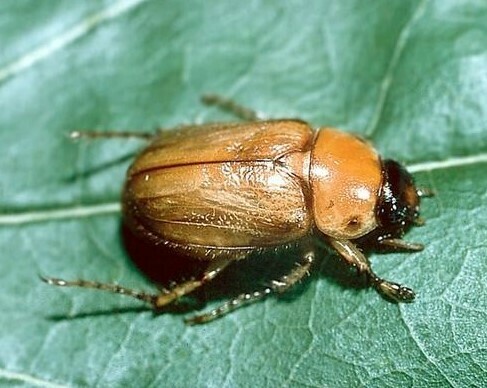
Adult beetles are brown with a black head and harmless to people. The white grubs grow to about 2.5 cm and feed on grass roots, harming lawns. Adults appear in June-July for a few weeks, then lay eggs underground.
Source: Wikipedia
Size
Adults are 10 to 14 mm long. Larvae (white grubs) reach about 2.5 cm in length.
Source: Wikipedia
Is it a pest in the house?
Adults cause no harm, but the grubs can damage grass roots and kill turf under dry conditions.
Source: Wikipedia
Does it bite or sting?
Adults are harmless and do not bite or sting.
Source: Wikipedia
How to get rid of it
Entomopathogenic fungi work in labs but are hard to use in the field. Applying insecticides before egg-laying season reduces natural predation.
Source: Wikipedia
Where it lives
It lives in the southeastern United States.
Source: Wikipedia
Life cycle
One generation per year; adults are active for a few weeks, then lay eggs underground. Larvae feed on roots until late spring, pupate, and adults emerge about two weeks later.
Source: Wikipedia
When you see it
Adults emerge in June and July, staying active for a few weeks.
Source: Wikipedia
Where it comes from
Native to the southeastern United States.
Source: Wikipedia
Lookalikes
A closely related species looks similar.
Source: Wikipedia
Where it is found in the US
Recorded in 40 of 51 states and DC. Most records: California, Texas, Florida, Virginia, Maryland, Ohio, Illinois, North Carolina.
Darker = more records. Counts are museum and citizen-science records, not population size.
Source: GBIF
Status: native in North America; native in United States. Source: iNaturalist
Months it is reported in the US
Source: GBIF
More photos
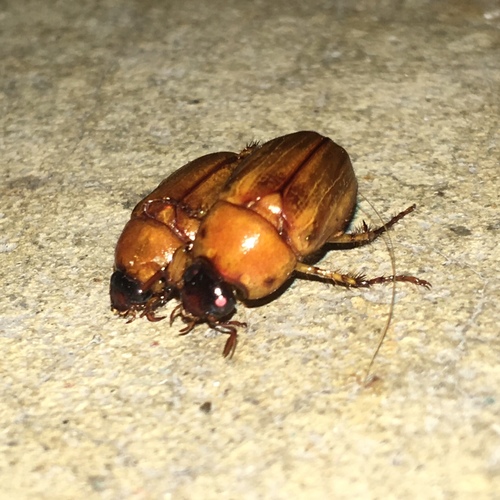
Questions people ask
Do southern masked chafer adults bite?
No, the adults are harmless and do not bite or sting.
Source: Wikipedia
When are the adults active?
Adults emerge in June and July and are active for only a few weeks.
Source: Wikipedia
How can I control them?
Applying insecticides before the beetles lay eggs can reduce their numbers, though it may affect natural predators.
Source: Wikipedia
Same family (Scarabaeidae)
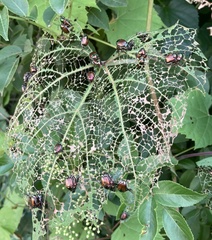 Japanese BeetlePopillia japonicaDamages trees, gardens or crops
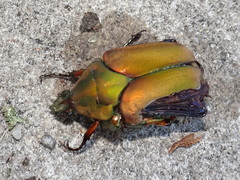 Common Green June BeetleCotinis nitidaDamages trees, gardens or crops
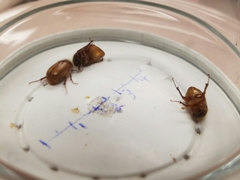 Phyllophaga crinitaPhyllophaga crinitaDamages trees, gardens or crops
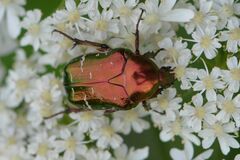 European Rose ChaferCetonia aurata
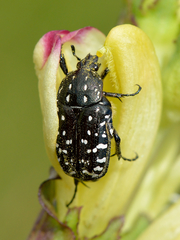 Mediterranean Spotted ChaferOxythyrea funestaDamages trees, gardens or crops
 Oriental BeetleExomala orientalisDamages trees, gardens or crops
Sources
- Wikipedia: https://en.wikipedia.org/wiki/Cyclocephala_lurida
Look it up elsewhere: GBIF · iNaturalist · BugGuide · ITIS · Wikipedia
Text written 2026-10-22 from the sources above and checked sentence by sentence against them. Data fetched 2026-10-22.