 Bug FAQ
Southern Cloudywing
Thorybes daunus · Order: Lepidoptera · Family: Hesperiidae
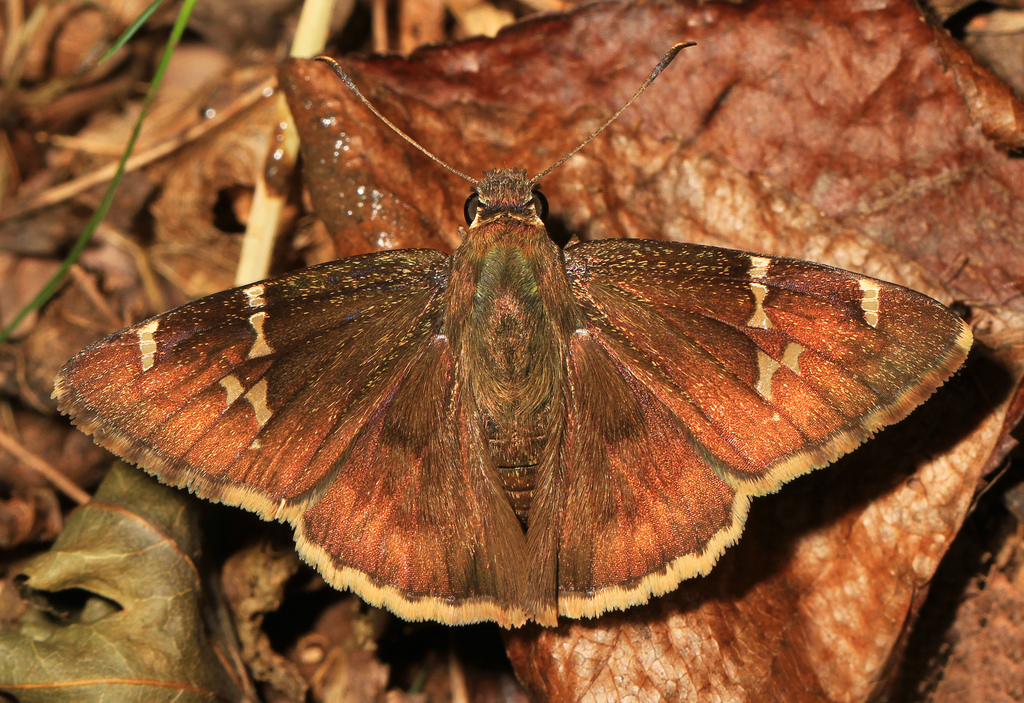
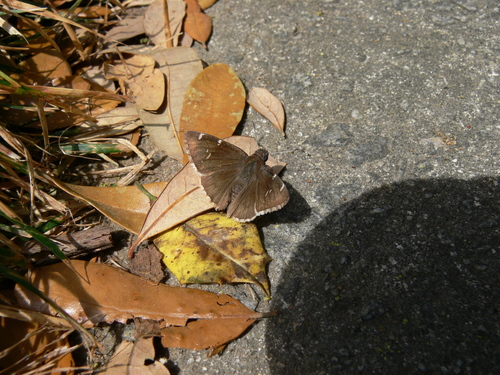
The southern cloudywing is a small North American skipper with a 32 to 38 mm wingspan and dark brown upper wings marked by a row of glassy white spots and, except in spring forms, an hourglass-shaped spot near the forewing costa. It lives in open areas such as streamsides, meadows, savannas, scrubby fields and woodlands, lays pale-green eggs on host-plant leaves, and its larvae build leaf shelters and overwinter as mature caterpillars.
Source: Wikipedia
How to recognize it
Near the leading edge of the forewing there is a conspicuous hourglass-shaped spot, which is absent in spring forms.
Source: Wikipedia
Size
Its wingspan measures about 32 to 38 mm (1.3 to 1.5 in).
Source: Wikipedia
Where it lives
It can be found in many open habitats, including along streams, in meadows, savannas, scrubby fields and woodlands.
Source: Wikipedia
Life cycle
It overwinters as a mature larva. In the north it has one generation per year, while in the south it can have two or three.
Source: Wikipedia
Where it comes from
The southern cloudywing is a North American butterfly in the skipper family Hesperiidae.
Source: Wikipedia
Lookalikes
It may be confused with the northern cloudywing and the confused cloudywing. The northern cloudywing can be told apart by its brown palps, a non-continuous white eye ring, and a forewing costal fold in males.
Source: Wikipedia
Where it is found in the US
Recorded in 36 of 51 states and DC. Most records: South Carolina, Michigan, Ohio, Florida, North Carolina, Georgia, Illinois, Massachusetts.
Darker = more records. Counts are museum and citizen-science records, not population size.
Source: GBIF
Status: native in North America; native in Canada; native in United States. Source: iNaturalist
Months it is reported in the US
Source: GBIF
More photos
Questions people ask
When can I see a southern cloudywing?
In the north they fly from June to mid-July; in the south they are active from March through November.
Source: Wikipedia
What does a southern cloudywing look like?
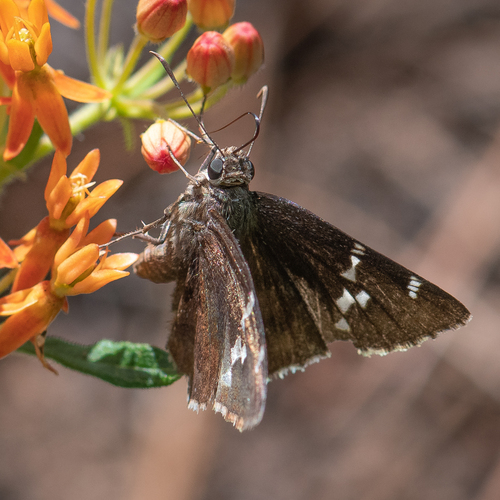
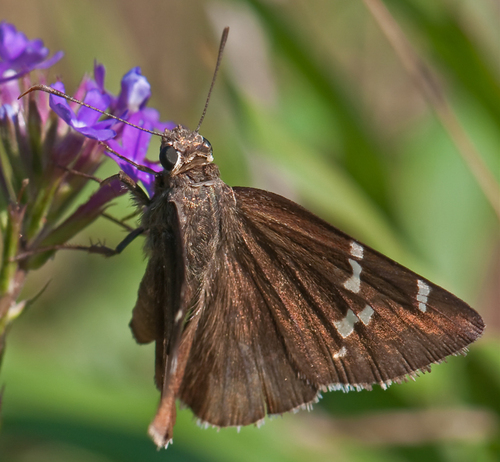
It has dark brown upper wings with a row of glassy white spots near the forewing edge and, except in spring forms, an hourglass-shaped spot near the wing’s leading edge.
Source: Wikipedia
Where does this butterfly live?
It prefers open places such as stream banks, meadows, savannas, scrubby fields and woodlands.
Source: Wikipedia
How can I tell it apart from similar species?
Look for the hourglass spot and continuous white eye ring; the northern cloudywing lacks the hourglass spot, has brown palps, a broken eye ring and a forewing costal fold in males.
Source: Wikipedia
Same family (Hesperiidae)



Sources
- Wikipedia: https://en.wikipedia.org/wiki/Thorybes_bathyllus
Look it up elsewhere: GBIF · iNaturalist · BugGuide · Wikipedia
Text written 2026-10-23 from the sources above and checked sentence by sentence against them. Data fetched 2026-10-23.