 Bug FAQ
Fiery Skipper
Hylephila phyleus · Order: Lepidoptera · Family: Hesperiidae
Also called: Fiery Skipperling
Source: Wikipedia

Adult fiery skippers are about an inch long; males are orange or yellow and females are dark brown, both showing small brown spots on their wings. They live in urban areas and are closely tied to turfgrass, especially Bermuda grass, and can be controlled with targeted insecticide or a pyrethrin/detergent spray.
Source: Wikipedia
How to recognize it
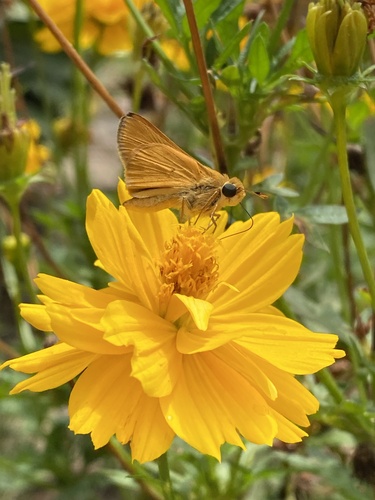
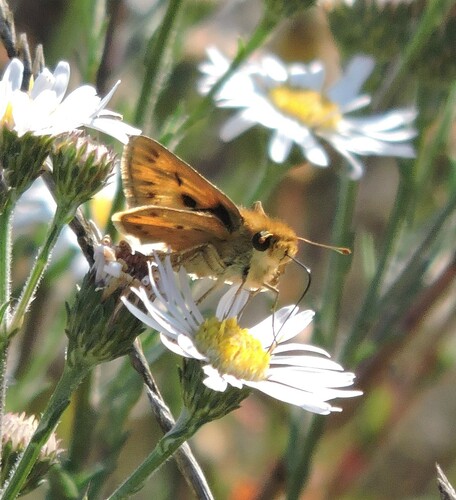
Males are orange or yellow, females are dark brown, and both sexes may have small brown spots on the fore- and hind-wings.
Source: Wikipedia
Size
Adults reach about 1 inch (2.5 cm) in length, with mature individuals up to 25 mm long.
Source: Wikipedia
How to get rid of it
Apply insecticide if a survey finds 15 or more larvae per plot.
Source: Wikipedia
Where it lives
They are often found in urban settings and have a close relationship with turfgrass such as Bermuda grass.
Source: Wikipedia
What it eats
Larvae feed on Bermuda grass, creeping bentgrass, and St. Augustine grass, making them lawn pests.
Source: Wikipedia
Life cycle
Mating occurs soon after emergence and adults live 6 to 11 days.
Source: Wikipedia
Where it comes from
The fiery skipper ranges widely across North and South America, from Canada down to Argentina.
Source: Wikipedia
Where it is found in the US
Recorded in 48 of 51 states and DC. Most records: Texas, California, Florida, North Carolina, Georgia, Illinois, South Carolina, Virginia.
Darker = more records. Counts are museum and citizen-science records, not population size.
Source: GBIF
Status: native in North America. Source: iNaturalist
Months it is reported in the US
Source: GBIF
More photos
Questions people ask
How do I control fiery skipper larvae?
Treat the turf with an appropriate insecticide when you count 15 or more larvae per surveyed area, or use a spray of 0.0015 % pyrethrins or 0.25 % detergent mixed with 4 L water.
Source: Wikipedia
What do fiery skipper caterpillars eat?
The caterpillars feed on Bermuda grass, creeping bentgrass, and St. Augustine grass.
Source: Wikipedia
When are fiery skippers most likely to appear in my yard?
They can move northward in the summer months, reaching the northern United States and southern Ontario.
Source: Wikipedia
How can I tell male and female fiery skippers apart?
Males are orange or yellow, while females are dark brown; both may show small brown spots on their wings.
Source: Wikipedia
Same family (Hesperiidae)



Sources
- Wikipedia: https://en.wikipedia.org/wiki/Fiery_skipper
Look it up elsewhere: GBIF · iNaturalist · BugGuide · ITIS · Wikipedia
Text written 2026-10-23 from the sources above and checked sentence by sentence against them. Data fetched 2026-10-22.