 Bug FAQ
South American Tropical Buckeye
Junonia evarete · Order: Lepidoptera · Family: Nymphalidae
Also called: Black Mangrove Buckeye, Mangrove Buckeye, Tropical Buckeye, West Indian Buckeye

The South American Tropical Buckeye has distinctive eye spots on its wings and a wingspan of about 4.5 to 6.5 cm. It lives in sunny, open fields and various forested or urban habitats across tropical and subtropical South America. Adults feed on nectar, while females lay single eggs on the undersides of leaves of plants such as mock vervain, Cayenne snakeweed, and white mangrove.
Source: Wikipedia
How to recognize it
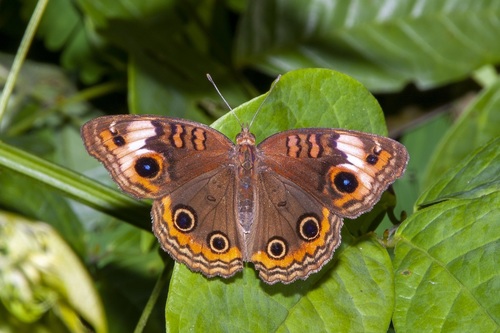
The butterfly is recognized by eye-spot markings on its wings.
Source: Wikipedia
Size
Its wingspan ranges from 4.5 cm to 6.5 cm (about 1.8 to 2.6 in).
Source: Wikipedia
Where it lives
It flies fast and low, preferring open, sunny fields.
Source: Wikipedia
What it eats
Adult butterflies feed on flower nectar.
Source: Wikipedia
Life cycle
Females lay individual eggs on the undersides of host-plant leaves.
Source: Wikipedia
Where it comes from
The species is found in tropical and subtropical regions of South America.
Source: Wikipedia
Lookalikes
It is often confused with the mangrove buckeye, Junonia genoveva.
Source: Wikipedia
Where it is found in the US
Recorded in 10 of 51 states and DC. Most records: Florida, Arizona, Texas, New Mexico, Oklahoma, California, Kansas, Utah.
Darker = more records. Counts are museum and citizen-science records, not population size.
Source: GBIF
Months it is reported in the US
Source: GBIF
More photos
Questions people ask
What are the eye spots on the Tropical Buckeye?
The butterfly has characteristic eye-spot markings on its wings.
Source: Wikipedia
Where does the South American Tropical Buckeye live?
It lives in open, sunny fields and a variety of forested, island, urban, and suburban habitats across tropical South America.
Source: Wikipedia
What plants do the caterpillars use as hosts?
Females lay eggs on leaves of mock vervain, Cayenne snakeweed, and white mangrove, which serve as host plants for the larvae.
Source: Wikipedia
How can I tell it apart from similar butterflies?
It is frequently mistaken for Junonia genoveva, the mangrove buckeye, because both have many variations and seasonal forms.
Source: Wikipedia
Same family (Nymphalidae)






Sources
- Wikipedia: https://en.wikipedia.org/wiki/Junonia_evarete
Look it up elsewhere: GBIF · iNaturalist · BugGuide · ITIS · Wikipedia
Text written 2026-10-22 from the sources above and checked sentence by sentence against them. Data fetched 2026-10-22.