 Bug FAQ
South American Fruit Tree Weevil
Naupactus xanthographus · Order: Coleoptera · Family: Curculionidae
Source: Wikipedia
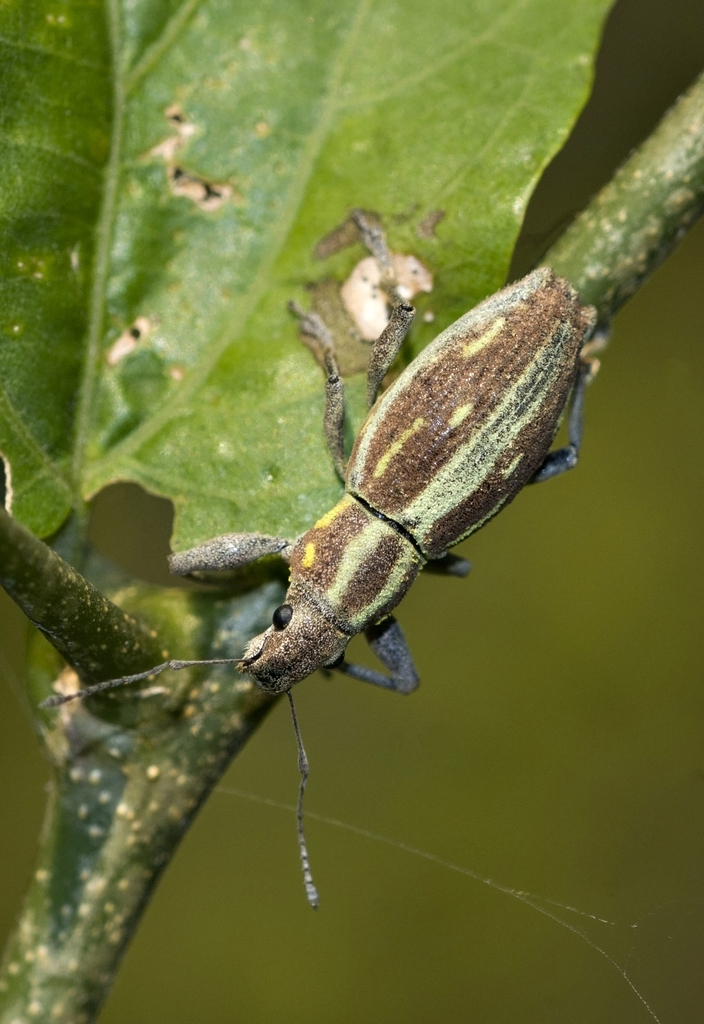
Adults are 11 to 14 mm long and have fused wing covers with yellow-lined scales that change colour with the seasons (brown in winter, yellow-green in spring-summer). It feeds on more than 45 species of fruit trees, making it a serious pest for orchards and other crops.
Source: Wikipedia
How to recognize it
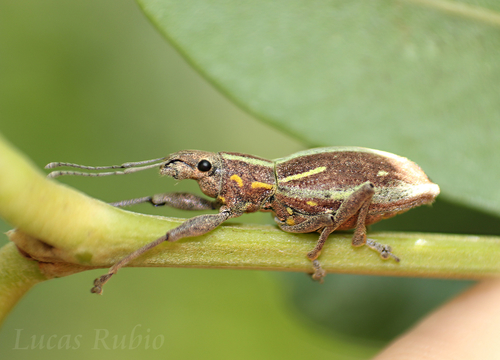
The beetle’s elytra are fused together and bear pigmented scales that form yellow lines, which turn brown and ashy gray in winter and become yellow-green in warmer months.
Source: Wikipedia
Size
Adults measure between 11 mm and 14 mm in length.
Source: Wikipedia
What it eats
The species feeds on more than 45 fruit-tree species of agricultural importance.
Source: Wikipedia
When you see it
Scale colour changes with the season: brown and ashy gray in winter, yellow and green lines in spring-summer.
Source: Wikipedia
Where it comes from
It is native to the Southern Cone of South America, from the Tropic of Capricorn down to about 41° S, and has also been recorded on Easter Island.
Source: Wikipedia
More photos
Questions people ask
What trees does the South American Fruit Tree Weevil damage?
It attacks over 45 species of fruit trees that are important to agriculture.
Source: Wikipedia
How can I tell the weevil’s season by its colour?
In winter the scales look brown and ashy gray; in spring and summer they show yellow-green lines.
Source: Wikipedia
How big is an adult South American Fruit Tree Weevil?
Adults are medium-sized, ranging from 11 mm to 14 mm long.
Source: Wikipedia
Same family (Curculionidae)
 Green Immigrant Leaf WeevilPolydrusus formosusDamages trees, gardens or crops
 Black Vine WeevilOtiorhynchus sulcatusDamages trees, gardens or crops
 Nettle weevilPhyllobius pomaceusDamages trees, gardens or crops
 Asian Oak WeevilCyrtepistomus castaneusDamages trees, gardens or crops
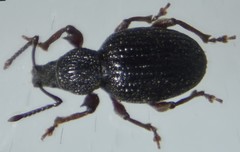 Strawberry Root WeevilOtiorhynchus ovatusDamages trees, gardens or crops
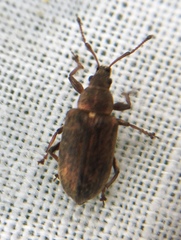 Common Leaf WeevilPhyllobius pyriDamages trees, gardens or crops
Sources
- Wikipedia: https://en.wikipedia.org/wiki/Naupactus_xanthographus
Look it up elsewhere: GBIF · iNaturalist · BugGuide · Wikipedia
Text written 2026-10-23 from the sources above and checked sentence by sentence against them. Data fetched 2026-10-22.