 Bug FAQ
Sooty Copper
Lycaena tityrus · Order: Lepidoptera · Family: Lycaenidae
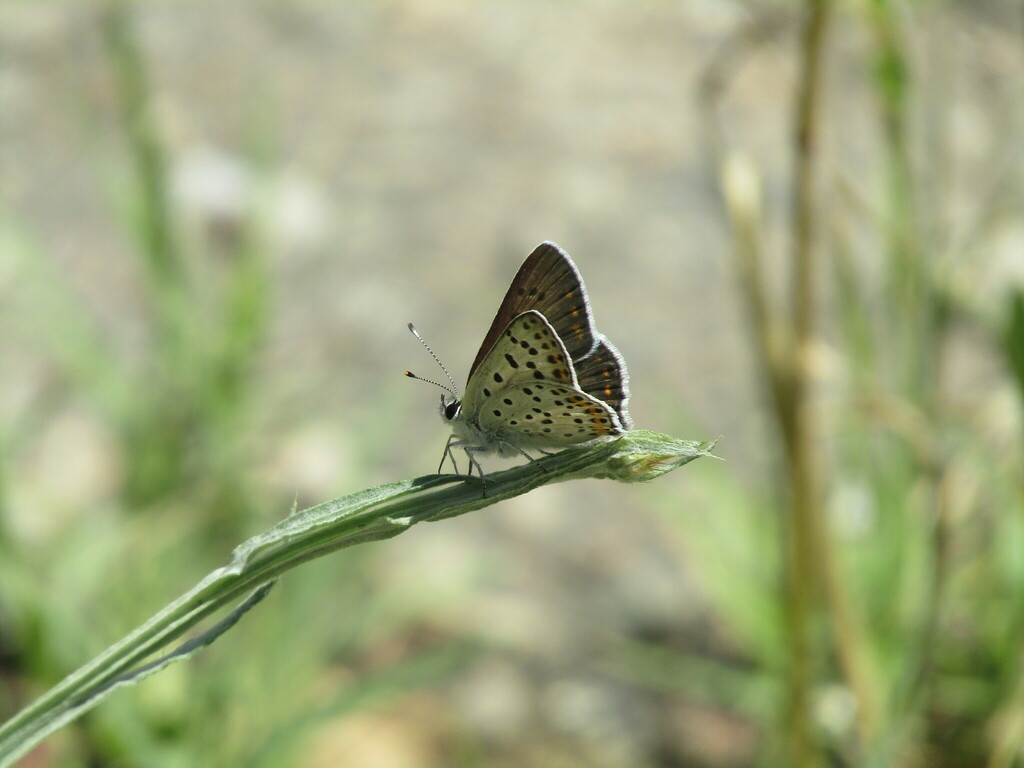
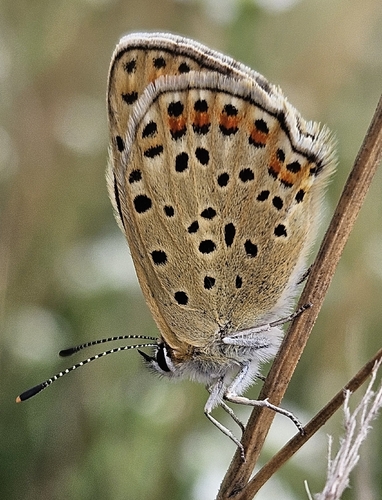
The male Sooty Copper has a dark brown upper side with a bright metallic green sheen when alive and a thin reddish crescent near the hindwing edge; the female is paler yellow with only a thin black border. It lives on sunny roadsides, fields and forest tracks, and can be found up to high alpine areas such as the Seiser Alp.
Source: Wikipedia
How to recognize it
Females resemble the Small Copper (phlaeas) but are paler yellow and have only a thin black edge instead of a broad marginal band.
Source: Wikipedia
Where it lives
In the Alps it climbs to sub-alpine heights such as the Seiser Alp.
Source: Wikipedia
What it eats
Adults feed on Rumex during hibernation and again in summer, and also visit Potentilla, Ranunculus, Chrysanthemum, Thymus and Leontodon depending on the season.
Source: Wikipedia
Life cycle
The species is on the wing throughout summer, with up to three overlapping generations in southern areas.
Source: Wikipedia
When you see it
Adults are present all summer, and in the south there can be three overlapping broods.
Source: Wikipedia
Lookalikes
Some forms show altered underside patterns, such as ab. strandi with stripe-like submarginal dots and ab. brunnea lacking the coppery sheen; in certain locales it may hybridise with related species like alciphron.
Source: Wikipedia
More photos
Questions people ask
How can I tell a male Sooty Copper from other copper butterflies?
Look for a dark brown upper side with a vivid metallic green shine when the butterfly is fresh, plus a thin reddish crescent near the hindwing edge.
Source: Wikipedia
What plants do Sooty Coppers visit for nectar?
They feed on Rumex and, depending on the season, also visit Potentilla, Ranunculus, Chrysanthemum, Thymus and Leontodon.
Source: Wikipedia
Where am I likely to see a Sooty Copper?
They are common on sunny roadsides, fields and forest tracks, and can be found up to sub-alpine heights in the Alps.
Source: Wikipedia
Is the Sooty Copper found in Great Britain?
No, its European range excludes Great Britain.
Source: Wikipedia
Same family (Lycaenidae)

Sources
- Wikipedia: https://en.wikipedia.org/wiki/Lycaena_tityrus
Look it up elsewhere: GBIF · iNaturalist · BugGuide · Wikipedia
Text written 2026-10-22 from the sources above and checked sentence by sentence against them. Data fetched 2026-10-22.