 Bug FAQ
Smith's Dragonfly
Hemicordulia smithii · Order: Odonata · Family: Corduliidae
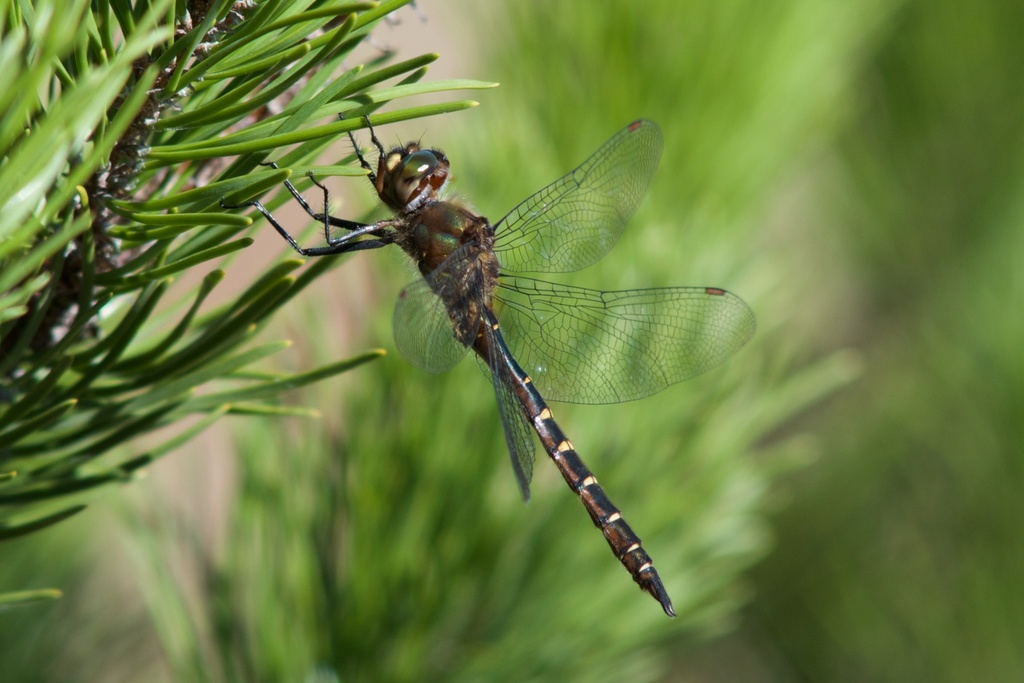
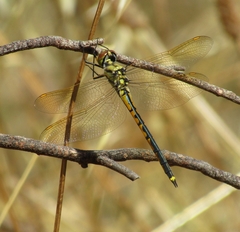
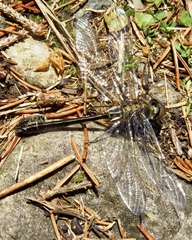
Smith's dragonfly is a medium-sized dragonfly about 46 to 50 mm long, with large globe-shaped eyes that meet on top of the head. Males have green iridescent eyes while females have brown eyes without iridescence, and the long, slightly flattened abdomen is dark with pale-yellow transverse stripes visible in flight.
Source: Wikipedia
How to recognize it
The eyes are large, globe-like and meet at the top of the head. Males show green iridescent eyes; females have brown eyes lacking iridescence. The abdomen is long, tubular, slightly flattened and dark, with bright pale-yellow intersegmental membranes that look like narrow illuminated stripes when the dragonfly flies.
Source: Wikipedia
Size
Adults measure about 46 to 50 mm in length.
Source: Wikipedia
Where it lives
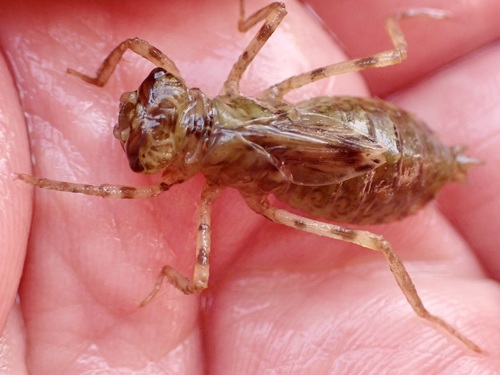
Adults are usually found near streams, and their shed skins (exuviae) are common near ponded or slow-flowing water.
Source: Wikipedia
What it eats
Both larvae and adults hunt small flying insects and are efficient predators in freshwater ecosystems.
Source: Wikipedia
Life cycle
Like other dragonflies, it develops directly from larva to adult without a pupal stage. The whole life cycle takes roughly four years to complete.
Source: Wikipedia
Where it comes from
The species is now considered endemic to New Zealand, though it is closely related to Australian and Pacific dragonflies.
Source: Wikipedia
Lookalikes
It resembles its close relative Hemicordulia grayi.
Source: Wikipedia
More photos

Questions people ask
How can I tell male and female Smith's dragonflies apart?
Males have green iridescent eyes; females have brown eyes without iridescence.
Source: Wikipedia
Where does Smith's dragonfly live?
It inhabits a wide range of freshwater habitats, especially streams and nearby slow-flowing waters.
Source: Wikipedia
Same family (Corduliidae)


Sources
- Wikipedia: https://en.wikipedia.org/wiki/Hemicordulia_smithii
Look it up elsewhere: GBIF · iNaturalist · BugGuide · Wikipedia
Text written 2026-10-23 from the sources above and checked sentence by sentence against them. Data fetched 2026-10-23.