 Bug FAQ
Small Whiteface
Leucorrhinia dubia · Order: Odonata · Family: Libellulidae
Also called: White-Faced Darter, White-Faced Dragonfly
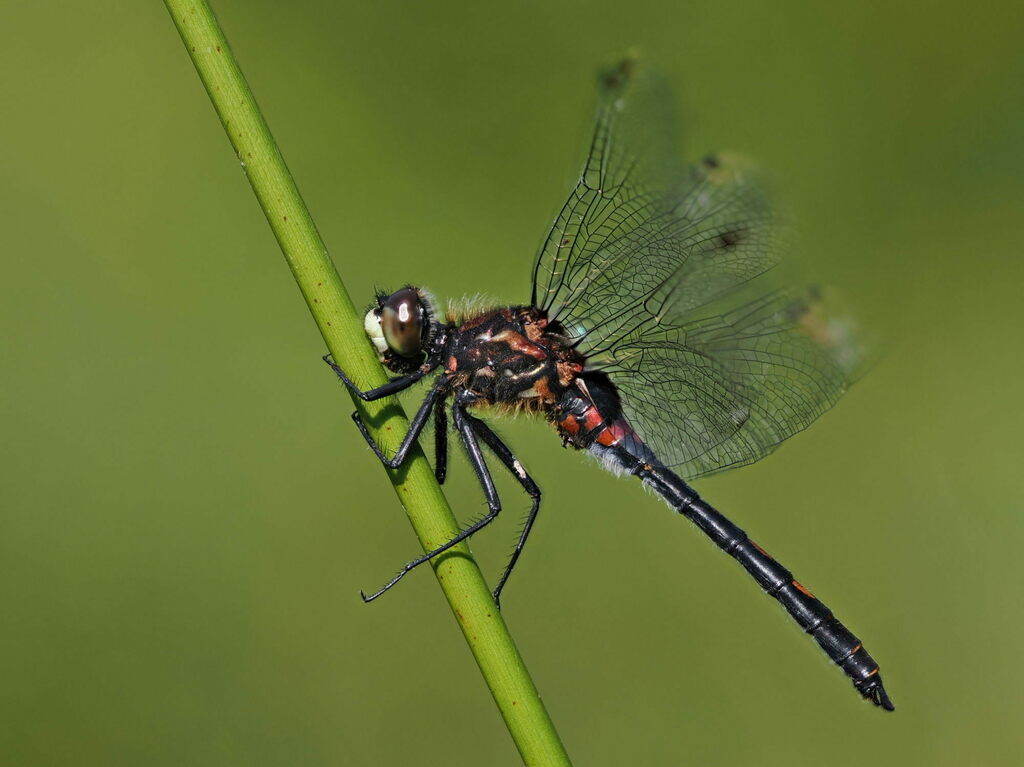
It is a small dragonfly about 33 to 37 mm long, with a black body and a white face patch. It lives in wetlands, peat bogs and marshy areas across northern and eastern Europe to Siberia, and adults can also use scrub and woodland for roosting. Adults fly from April to September, taking one to three years to develop from larvae that feed day and night, especially at night.
Source: Wikipedia
How to recognize it
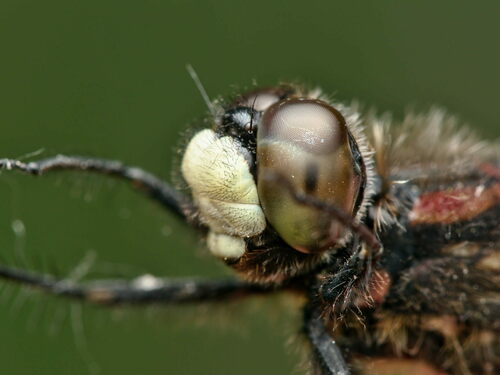
All individuals have a conspicuous white frons, a brown patch at the wing base, and black pterostigma.
Source: Wikipedia
Size
Body length is 33 to 37 mm; abdomen 21 to 27 mm; hindwing 23 to 28 mm.
Source: Wikipedia
Where it lives
Larvae need marshes, wetlands and peat bogs with edge vegetation; adults may roost and forage in scrub and woodland.
Source: Wikipedia
What it eats
Larvae live in sphagnum moss, which traps organic matter for food. Larvae actively hunt both day and night, catching more prey at night.
Source: Wikipedia
Life cycle
It typically takes 1 to 3 years to reach adulthood.
Source: Wikipedia
When you see it
Adults are active from April through September; emergence occurs May to early July in Great Britain.
Source: Wikipedia
Where it comes from
Found from western Europe across northern and eastern Europe to Siberia and Japan, common at higher altitudes, rare in southern Europe and the UK.
Source: Wikipedia
Lookalikes
It may be confused with black darter, ruddy darter, or common darter, but the white face patch distinguishes it.
Source: Wikipedia
Where it is found in the US
Recorded in 1 of 51 states and DC. Most records: Pennsylvania.
Darker = more records. Counts are museum and citizen-science records, not population size.
Source: GBIF
More photos
Questions people ask
How can I tell this dragonfly apart from similar species?
Look for the distinctive white patch on the face; other darters lack this feature.
Source: Wikipedia
When are adult Small Whitefaces active?
Adults fly from April to September, with emergence in May to early July in Britain.
Source: Wikipedia
What habitats does this species need?
Larvae require wet marshes, peat bogs or wetlands with edge vegetation, while adults may use scrub and woodland for roosting.
Source: Wikipedia
Same family (Libellulidae)

Sources
- Wikipedia: https://en.wikipedia.org/wiki/White-faced_darter
Look it up elsewhere: GBIF · iNaturalist · BugGuide · Wikipedia
Text written 2026-10-23 from the sources above and checked sentence by sentence against them. Data fetched 2026-10-22.