 Bug FAQ
Small Blue
Cupido minimus · Order: Lepidoptera · Family: Lycaenidae
Also called: Eurasian Small Blue, Little Blue

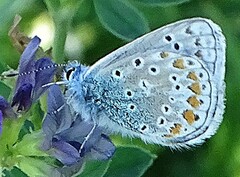
The Small Blue (Cupido minimus) is a tiny butterfly with a wingspan of about 16-27 mm, males being the smaller sex. Males are dark brown with bright blue speckles on the wings, and both sexes have a silver underside marked with black spots. It lives on calcareous grasslands, old quarries, railway embankments and woodland edges, and in the UK it relies on kidney vetch for its larvae.
Source: Wikipedia
How to recognize it
Males are dark brown with scattered bright blue scales on the wings; both sexes show a silver underside with black spots.
Source: Wikipedia
Size
Wingspan ranges from 16 to 27 mm, with males generally smaller than females.
Source: Wikipedia
What it eats
Larvae feed on a range of legume plants such as kidney vetch, Lotus corniculatus, Anthyllis vulneraria and various Astragalus species.
Source: Wikipedia
Life cycle
It is the smallest butterfly species in the United Kingdom.
Source: Wikipedia
When you see it
Active during the day and often found in colonies.
Source: Wikipedia
Lookalikes
Can be mistaken for the female Osiris Blue, which has a similar colour pattern.
Source: Wikipedia
More photos


Questions people ask
What plants do Small Blue caterpillars eat?
They feed on legumes such as kidney vetch, Lotus corniculatus, Anthyllis vulneraria and several Astragalus species.
Source: Wikipedia
Same family (Lycaenidae)

Sources
- Wikipedia: https://en.wikipedia.org/wiki/Small_blue
Look it up elsewhere: GBIF · iNaturalist · BugGuide · Wikipedia
Text written 2026-10-22 from the sources above and checked sentence by sentence against them. Data fetched 2026-10-22.