 Bug FAQ
Silver-banded Hairstreak
Chlorostrymon simaethis · Order: Lepidoptera · Family: Lycaenidae
Also called: Silverbanded Hairstreak, Simaethis Hairstreak
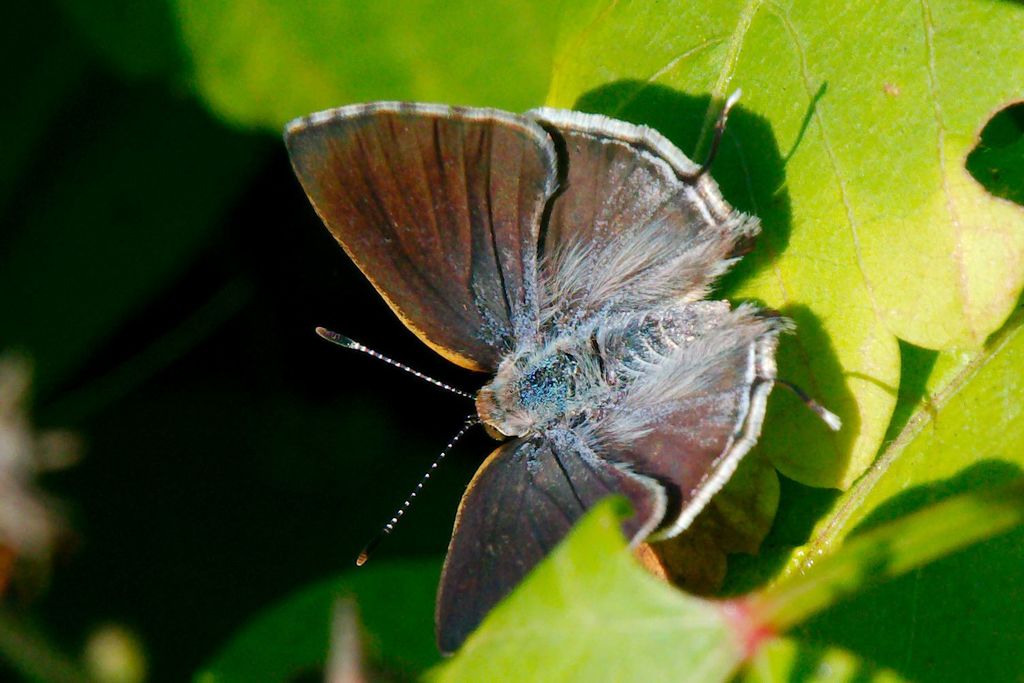
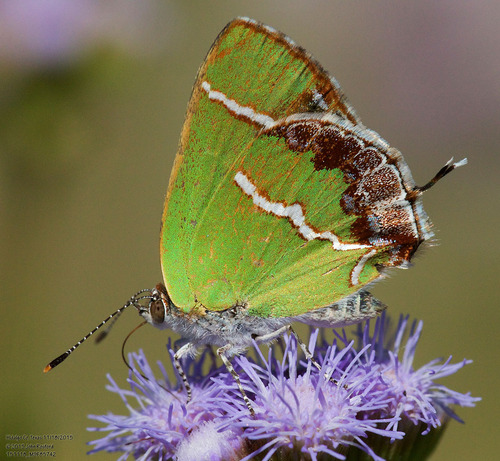
The silver-banded hairstreak is a small North and South American butterfly with a wingspan of about 2.2 to 3.2 cm and bright lime-green undersides. It lives in subtropical woodlands, deserts and hammock edges where its host vines such as balloon vine are present.
Source: Wikipedia
How to recognize it
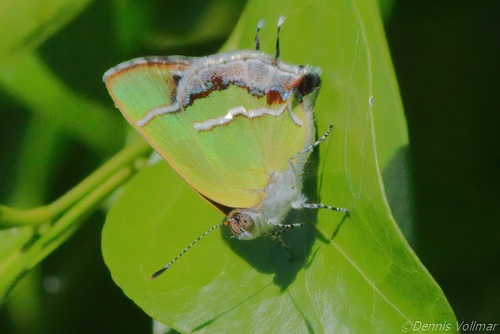
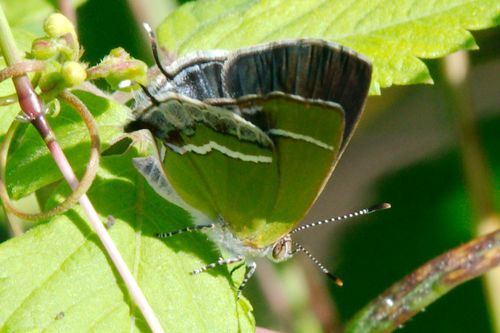
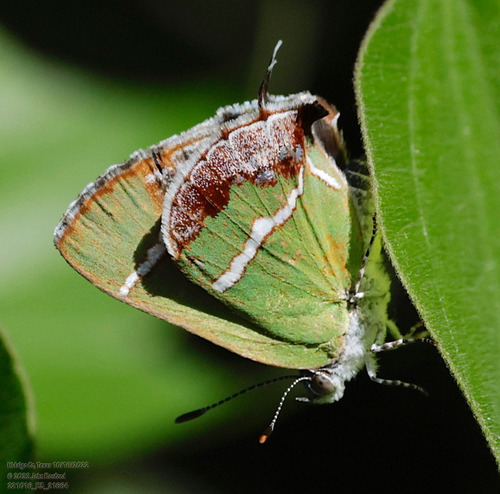
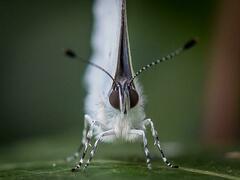
Males have dark iridescent purple upper wings, while both sexes show bright lime-green undersides. A bright silvery-white band runs across both wings, forming a V-shaped jut on the hindwing. Beyond the silver band is a dark brown-red patch that may have some silvery frosting. The hindwings have one pair of tails.
Source: Wikipedia
Where it lives
It inhabits subtropical woodlands, deserts and hammock edges, but only where its host plants grow nearby.
Source: Wikipedia
What it eats
Caterpillars live inside seed pods of balloon vine, faux persil or Florida Keys thoroughwort and eat the unripe seeds.
Source: Wikipedia
Life cycle
Females lay single eggs on young fruits of the host plant. The caterpillars are yellow-green to brown, turning red just before pupation. There are two or three generations each year.
Source: Wikipedia
When you see it
Adults appear May-December in southern Florida, June-December in southern Texas, and March-June and again October-mid-November in southern Arizona.
Source: Wikipedia
Where it comes from
The silver-banded hairstreak is native to North and South America.
Source: Wikipedia
Lookalikes
The only similar species in its range is the amethyst hairstreak, and another related North American species is the xami (green) hairstreak.
Source: Wikipedia
Where it is found in the US
Recorded in 7 of 51 states and DC. Most records: Texas, Florida, Arizona, California, Kansas, Utah, New Mexico.
Darker = more records. Counts are museum and citizen-science records, not population size.
Source: GBIF
Status: native in North America; native in United States. Source: iNaturalist
Months it is reported in the US
Source: GBIF
More photos
Questions people ask
When can I see the silver-banded hairstreak?
In southern Florida you’ll see it from May through December; in southern Texas from June to December; and in southern Arizona in spring and again in fall.
Source: Wikipedia
What plants do the caterpillars feed on?
They feed inside the seed pods of balloon vine, faux persil, and Florida Keys thoroughwort, eating the unripe seeds.
Source: Wikipedia
How many generations does this butterfly have each year?
It produces two or three broods annually.
Source: Wikipedia
What other butterflies look like the silver-banded hairstreak?
The amethyst hairstreak is the only similar species in its range, and the xami (green) hairstreak is another related North American species.
Source: Wikipedia
Same family (Lycaenidae)

Sources
- Wikipedia: https://en.wikipedia.org/wiki/Chlorostrymon_simaethis
Look it up elsewhere: GBIF · iNaturalist · BugGuide · ITIS · Wikipedia
Text written 2026-10-24 from the sources above and checked sentence by sentence against them. Data fetched 2026-10-24.