 Bug FAQ
Short-winged Blister Beetle
Meloe angusticollis · Order: Coleoptera · Family: Meloidae
Source: Wikipedia
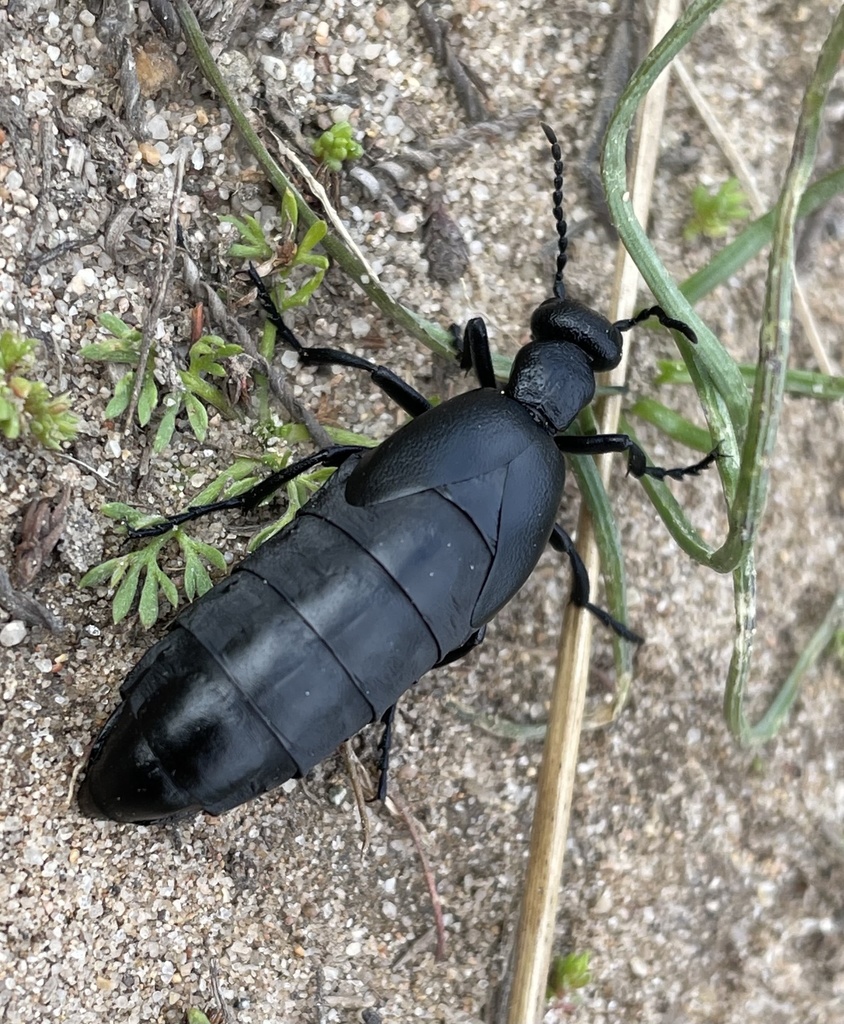
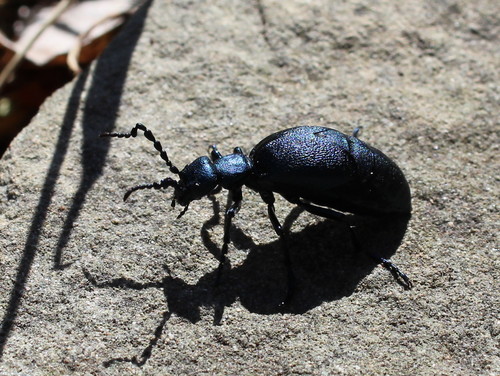
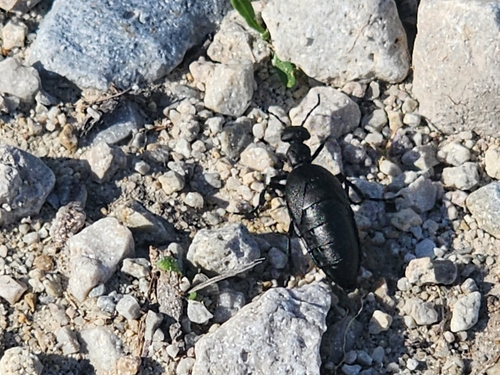
The short-winged blister beetle is black or metallic blue and has a densely punctured head and pronotum with a conical scutellum and short elytra. Adults release a cantharidin-containing fluid that can blister skin and the toxin is lethal if enough is ingested.
Source: Wikipedia
How to recognize it
It is black or metallic blue in color. The head and pronotum are densely punctate, the scutellum is conically produced, the elytra are short, and each leg has an outer metathoracic tibial spur that points forward.
Source: Wikipedia
Size
Adults range from about 9 to 19 mm long, with females noticeably larger than males.
Source: Wikipedia
Can it bite, sting or make you sick?
When disturbed, the beetle sprays oily droplets of hemolymph that can cause blistering on human skin. The toxin can be fatal if about 100 mg is swallowed.
Source: Wikipedia
Where it lives
They are most active in spring and early summer across the northern United States and southern Canada.
Source: Wikipedia
What it eats
Larvae hitch a ride on bees to reach bee nests where they feed.
Source: Wikipedia
Life cycle
They undergo complete metamorphosis: egg, larva, pupa, and adult stages. Typically there is one generation each year.
Source: Wikipedia
When you see it
Adults are active mainly in spring and early summer.
Source: Wikipedia
Where it comes from
The short-winged blister beetle is native to North America.
Source: Wikipedia
Lookalikes
The combination of dense punctation on the head and pronotum and a conically produced scutellum sets it apart from other Meloe species.
Source: Wikipedia
Where it is found in the US
Recorded in 32 of 51 states and DC. Most records: Kentucky, Pennsylvania, Utah, Idaho, Washington, Ohio, Virginia, Indiana.
Darker = more records. Counts are museum and citizen-science records, not population size.
Source: GBIF
Status: native in North America; native in Canada. Source: iNaturalist
Months it is reported in the US
Source: GBIF
More photos
Questions people ask
What does the beetle’s spray do to skin?
It releases oily hemolymph that can blister the skin.
Source: Wikipedia
How big are short-winged blister beetles?
Adults are about 9 to 19 mm long, with females larger than males.
Source: Wikipedia
When are they most likely to be seen?
They are active in spring and early summer in the northern US and southern Canada.
Source: Wikipedia
How can I tell this beetle apart from other oil beetles?
Look for dense punctation on the head and pronotum and a conical scutellum; the elytra are short and the legs have a forward-pointing tibial spur.
Source: Wikipedia
Same family (Meloidae)




Sources
- Wikipedia: https://en.wikipedia.org/wiki/Meloe_angusticollis
Look it up elsewhere: GBIF · iNaturalist · BugGuide · ITIS · Wikipedia
Text written 2026-10-26 from the sources above and checked sentence by sentence against them. Data fetched 2026-10-26.