 Bug FAQ
Violet Oil Beetle
Meloe violaceus · Order: Coleoptera · Family: Meloidae

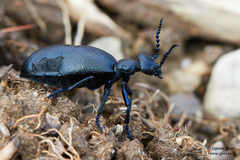
The violet oil beetle is a 10 to 30 mm long beetle, with females a bit larger than males. It is colored black-blue or violet-blue, with a finely dotted head and pronotum and short elytra. Adults live on sunny, dry spots with flowers where they eat pollen, while larvae are parasites of solitary bee nests.
Source: Wikipedia
How to recognize it
The beetle shows a black-blue or violet-blue hue, a finely dotted head and pronotum, and elytra that are shorter than the abdomen.
Source: Wikipedia
Size
Body length ranges from 10 to 30 mm, with females slightly larger than males.
Source: Wikipedia
Where it lives
Adults are found on sunny, dry areas with flowering plants.
Source: Wikipedia
What it eats
Adults feed on pollen from flowers. Larvae live as parasites, mainly inside solitary bee nests, occasionally in locust nests.
Source: Wikipedia
Life cycle
The species undergoes hypermetamorphosis, a complex metamorphosis with several distinct stages. After about a month, larvae hatch, climb onto grass or flowers, and wait to attach to passing pollinating insects.
Source: Wikipedia
When you see it
In May to June, females dig shallow cylindrical holes 20 to 30 mm deep to lay 2,000 to 10,000 eggs.
Source: Wikipedia
Where it comes from
It occurs across most of Europe, the eastern Palearctic, the Near East, and North Africa.
Source: Wikipedia
Same family (Meloidae)


Sources
- Wikipedia: https://en.wikipedia.org/wiki/Meloe_violaceus
Look it up elsewhere: GBIF · iNaturalist · BugGuide · Wikipedia
Text written 2026-10-22 from the sources above and checked sentence by sentence against them. Data fetched 2026-10-22.