 Bug FAQ
Black Blister Beetle
Epicauta pensylvanica · Order: Coleoptera · Family: Meloidae
Also called: Black aster bug
Source: extension.umaine.edu, extension.umd.edu, extensionpubs.unl.edu

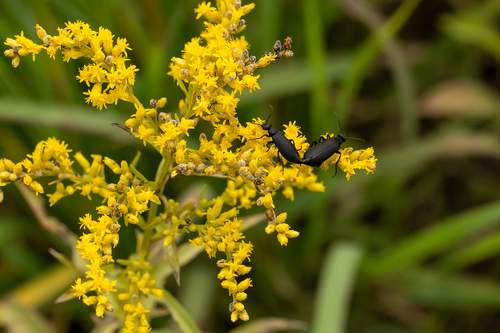
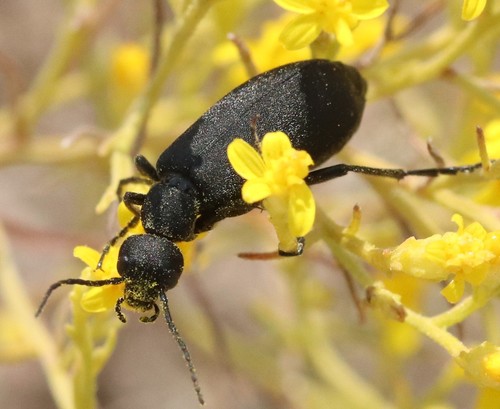
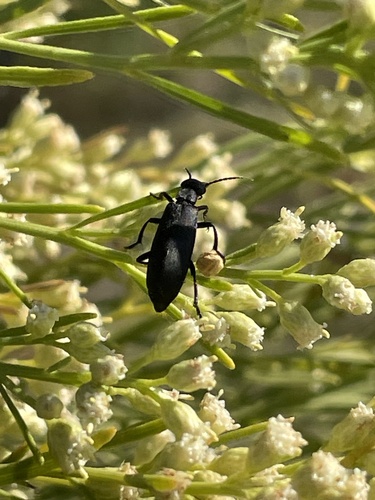
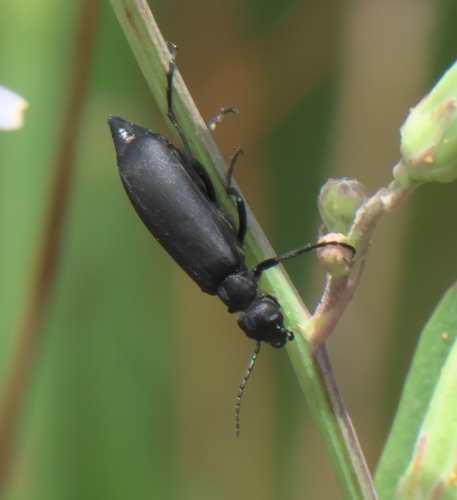
The black blister beetle (Epicauta pensylvanica) is a small, slender beetle about 7 to 15 mm long with a soft, flexible wing cover that may be black, gray, brown or yellow. When handled roughly the beetle releases cantharidin, an odorless chemical that creates temporary blisters on human skin.
Source: extension.umd.edu, extensionpubs.unl.edu, extension.umaine.edu
How to recognize it
Epicauta pensylvanica, called the black blister beetle, belongs to the Meloidae family of burning blister beetles.
Source: Wikipedia
Is it a pest in the house?
These beetles are gregarious and often gather in groups. They are highly toxic to horses; a few beetles eaten with alfalfa can be fatal.
Source: extension.umaine.edu
Does it bite or sting?
Cantharidin in the beetle’s hemolymph is a colorless fatty substance that blisters skin on contact.
Source: extension.umd.edu, extensionpubs.unl.edu
How to get rid of it
Beetles are attracted to lights at night, which often brings them into contact with people. Small numbers can be removed by hand-picking, preferably while wearing gloves.
Source: extension.umaine.edu, extension.umd.edu
When you see it
Adults can remain active into October.
Source: extensionpubs.unl.edu
Where it is found in the US
Recorded in 42 of 51 states and DC. Most records: Texas, Colorado, New Mexico, Kentucky, South Dakota, Pennsylvania, Kansas, Minnesota.
Darker = more records. Counts are museum and citizen-science records, not population size.
Source: GBIF
Status: native in North America; native in Canada. Source: iNaturalist
Months it is reported in the US
Source: GBIF
More photos
Questions people ask
Are they dangerous to pets or livestock?
They are especially dangerous to horses; ingesting a few beetles can be fatal.
Source: extension.umaine.edu
How can I prevent them from getting into my house?
Turn off outdoor lights at night or use yellow bulbs, and wear gloves when handling any that appear.
Source: extension.umaine.edu, extension.umd.edu
Same family (Meloidae)


Sources
- extension.umaine.edu: https://extension.umaine.edu/home-and-garden-ipm/common-name-listing/blister-beetles/
- extension.umd.edu: https://extension.umd.edu/resource/blister-beetles-flowers
- extensionpubs.unl.edu: https://extensionpubs.unl.edu/publication/g1645/na/html/view
- Wikipedia: https://en.wikipedia.org/wiki/Epicauta_pensylvanica
Look it up elsewhere: GBIF · iNaturalist · BugGuide · ITIS · Wikipedia
Text written 2026-10-22 from the sources above and checked sentence by sentence against them. Data fetched 2026-10-22.