 Bug FAQ
Sceliphron spirifex
Sceliphron spirifex · Order: Hymenoptera · Family: Sphecidae
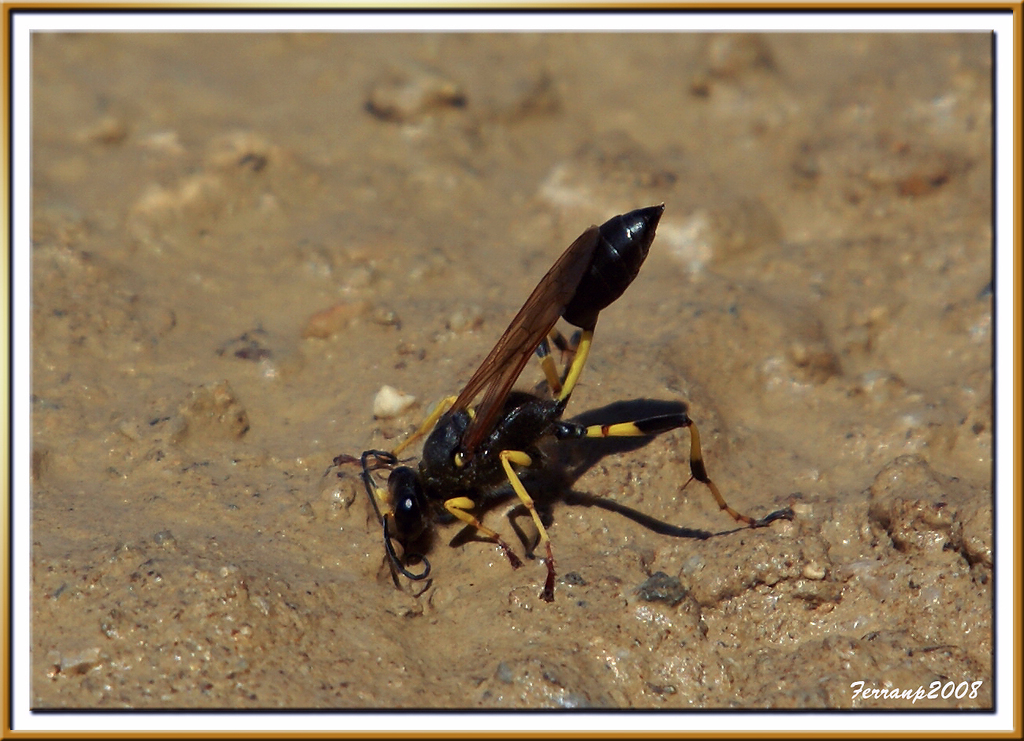
Sceliphron spirifex is a medium-sized mud-dauber wasp about 17 to 27 mm long, dark black with a long yellow waist and black legs banded with yellow. It builds large mud nests with many cells on cliffs, rocks, tree trunks, bridges and buildings, and provisions each cell with several spiders. The species lives in varied habitats across Africa and Southern Europe and is especially common around human structures.
Source: Wikipedia
How to recognize it
The wasp has a dull black body, a long yellow petiole, black legs with yellow bands, black antennae and clear wings.
Source: Wikipedia
Size
Adults measure about 17 to 27 mm (0.7 to 1.1 in) in length.
Source: Wikipedia
Is it a pest in the house?
The species is strongly associated with buildings and other human structures.
Source: Wikipedia
Where it lives
It occurs in many habitats throughout Africa and Southern Europe, often near buildings and other man-made structures.
Source: Wikipedia
What it eats
Females stock each mud cell with several spiders before sealing it.
Source: Wikipedia
Where it comes from
Its range includes Africa and Southern Europe.
Source: Wikipedia
Questions people ask
What does Sceliphron spirifex look like?
It is a medium-sized (17 to 27 mm) black wasp with a long yellow waist, black legs banded with yellow, black antennae and clear wings.
Source: Wikipedia
Where is Sceliphron spirifex found?
It lives across Africa and Southern Europe, especially around buildings and other man-made structures.
Source: Wikipedia
What does Sceliphron spirifex eat?
The female provisions each mud nest cell with several spiders.
Source: Wikipedia
Same family (Sphecidae)
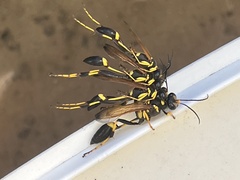 Yellow-legged Mud-dauber WaspSceliphron caementariumCan sting
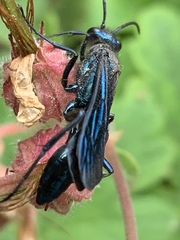 Common Blue Mud-dauber WaspChalybion californicumCan sting
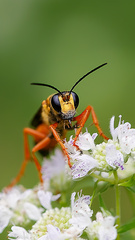 Great Golden Digger WaspSphex ichneumoneus
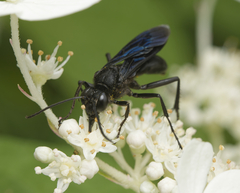 Great Black Digger WaspSphex pensylvanicusCan sting
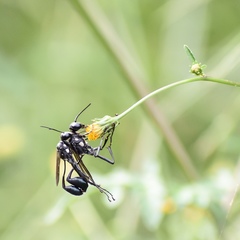 Gold-marked Thread-waisted WaspEremnophila aureonotata
 Mexican Grass-carrying WaspIsodontia mexicana
Sources
- Wikipedia: https://en.wikipedia.org/wiki/Sceliphron_spirifex
Look it up elsewhere: GBIF · iNaturalist · BugGuide · ITIS · Wikipedia
Text written 2026-10-23 from the sources above and checked sentence by sentence against them. Data fetched 2026-10-22.