 Bug FAQ
Sceliphron laetum
Sceliphron laetum · Order: Hymenoptera · Family: Sphecidae


The mud-dauber wasp measures about 17 to 26 mm in length (0.7 to 1.0 in). Its thorax tip, petiole and front gaster are yellow, the middle of the gaster is black and the rear end is yellow. Females build clusters of cylindrical mud cells to rear their young, adding extra mud ridges on the outside once the nest is finished. Each larva eats the spiders placed in its cell, then pupates and chews its way out as an adult. It can be told apart from the similar Sceliphron formosum by the lack of a bare yellow patch on the lower face.
Source: Wikipedia
Size
Adults are 17 to 26 mm long (about 0.67 to 1.02 in).
Source: Wikipedia
Where it lives
It is a solitary mud-dauber that builds mud cells for its larvae. The female constructs several cylindrical mud cells that are clustered together, then adds exterior ridges.
Source: Wikipedia
Life cycle
The female lays eggs on spiders, mainly Argiope or Neoscona species, though these are a small part of the total prey. Larvae consume all spiders in their cell, then pupate and emerge as adults by chewing out of the mud cell.
Source: Wikipedia
Lookalikes
It lacks the bare yellow skin on the lower face that Sceliphron formosum has.
Source: Wikipedia
Where it is found in the US
Recorded in 1 of 51 states and DC. Most records: Hawaii.
Darker = more records. Counts are museum and citizen-science records, not population size.
Source: GBIF
More photos


Questions people ask
What does this wasp look like?
Its thorax tip, petiole and front gaster are yellow, the middle of the gaster is black, and the rear end is yellow.
Source: Wikipedia
How does it build its nest?
The female builds clusters of cylindrical mud cells and adds extra mud ridges on the outside once the nest is complete.
Source: Wikipedia
Same family (Sphecidae)
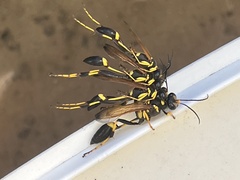 Yellow-legged Mud-dauber WaspSceliphron caementariumCan sting
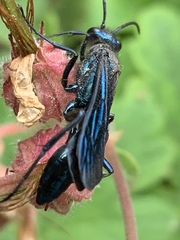 Common Blue Mud-dauber WaspChalybion californicumCan sting
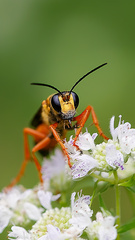 Great Golden Digger WaspSphex ichneumoneus
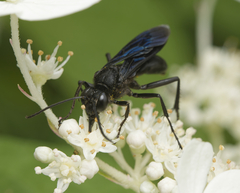 Great Black Digger WaspSphex pensylvanicusCan sting
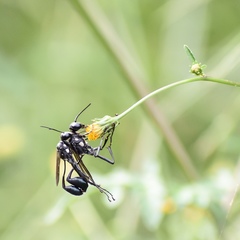 Gold-marked Thread-waisted WaspEremnophila aureonotata
 Mexican Grass-carrying WaspIsodontia mexicana
Sources
- Wikipedia: https://en.wikipedia.org/wiki/Sceliphron_laetum
Look it up elsewhere: GBIF · iNaturalist · BugGuide · ITIS · Wikipedia
Text written 2026-10-23 from the sources above and checked sentence by sentence against them. Data fetched 2026-10-23.