 Bug FAQ
Sceliphron asiaticum
Sceliphron asiaticum · Order: Hymenoptera · Family: Sphecidae
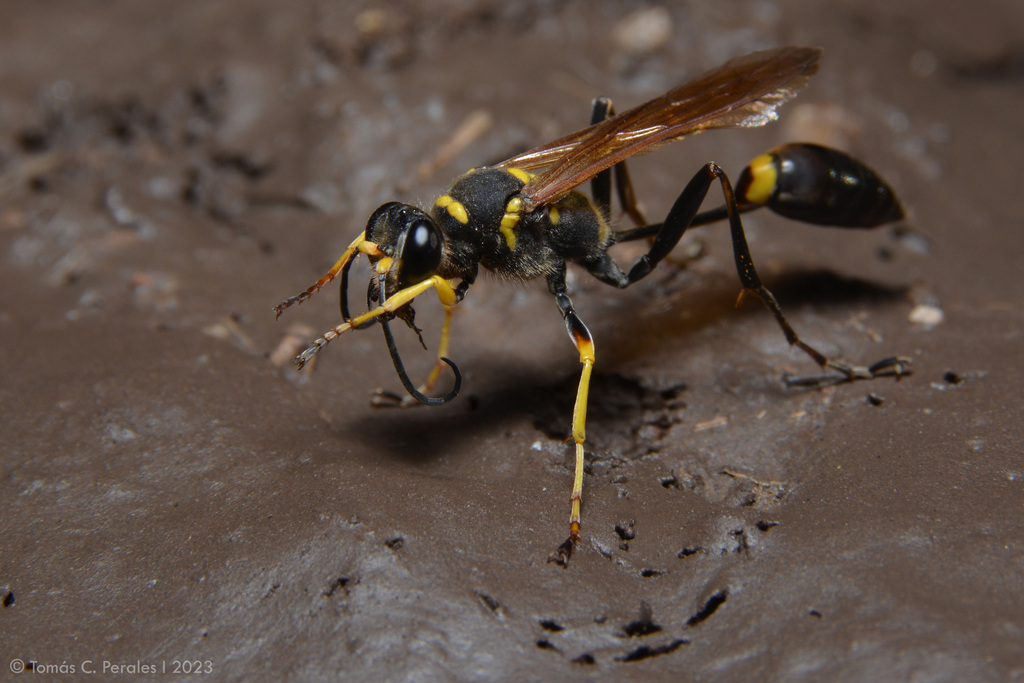
Adults have a black head and thorax with yellow bands, a long waist, and a mostly black abdomen except the first segment which is yellow. They build mud nests from sandy silt, detritus and faeces, and each cell is stocked with paralyzed running spiders for their larvae.
Source: Wikipedia
How to recognize it
The wasp has a black head, black thorax with yellow bands, a slender waist, and a black abdomen with the first segment yellow. Its antennae are black, wings are clear membranous, and the legs show both yellow and black coloration.
Source: Wikipedia
Is it a pest in the house?
A mud nest was found attached to a house, built from sandy silt, detritus and faeces.
Source: Wikipedia
Where it lives
It builds mud nests from sandy silt, incorporating detritus and faeces, and one such nest was found attached to a house in northeastern Brazil.
Source: Wikipedia
What it eats
Each nest cell is provisioned with one or more paralyzed running spiders to feed the developing larva.
Source: Wikipedia
Life cycle
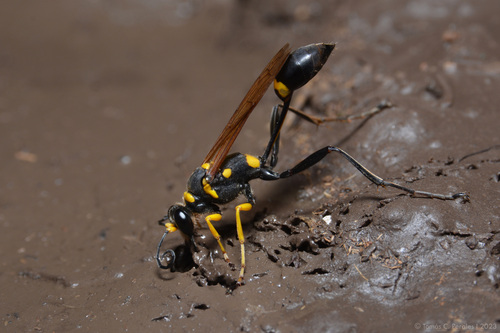
Females collect mud to construct cells where they lay a single egg, then stock each cell with spider parts for the larva.
Source: Wikipedia
Where it comes from
The subspecies S. a. chilense occurs only in Chile.
Source: Wikipedia
More photos
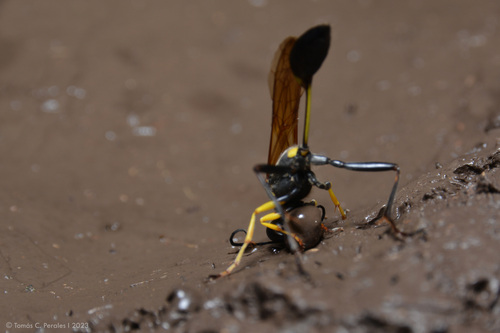
Questions people ask
How can I recognize Sceliphron asiaticum?
Look for a black head and thorax with yellow bands, a long waist, and a mostly black abdomen with the first segment yellow; legs are yellow and black and the antennae are black.
Source: Wikipedia
What does it use to feed its larvae?
Each nest cell is stocked with one or more paralyzed running spiders, which the larva eats as it develops.
Source: Wikipedia
Does it build nests in homes?
Yes, mud nests have been found attached to houses, made from sandy silt, detritus and faeces.
Source: Wikipedia
Same family (Sphecidae)
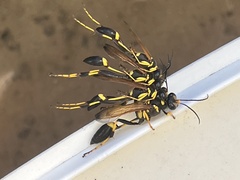 Yellow-legged Mud-dauber WaspSceliphron caementariumCan sting
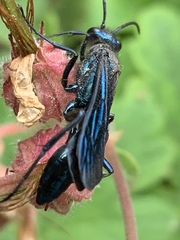 Common Blue Mud-dauber WaspChalybion californicumCan sting
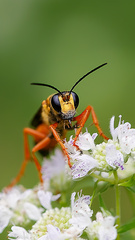 Great Golden Digger WaspSphex ichneumoneus
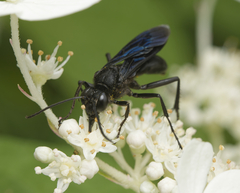 Great Black Digger WaspSphex pensylvanicusCan sting
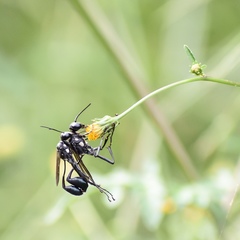 Gold-marked Thread-waisted WaspEremnophila aureonotata
 Mexican Grass-carrying WaspIsodontia mexicana
Sources
- Wikipedia: https://en.wikipedia.org/wiki/Sceliphron_asiaticum
Look it up elsewhere: GBIF · iNaturalist · BugGuide · ITIS · Wikipedia
Text written 2026-10-23 from the sources above and checked sentence by sentence against them. Data fetched 2026-10-23.