 Bug FAQ
Ringed Paper Wasp
Polistes annularis · Order: Hymenoptera · Family: Eumenidae
Also called: Jack Spaniard Paper Wasp, Jack Spaniard Wasp
Source: Wikipedia

The ringed paper wasp builds hidden nests under overhangs on trees, shrubs, or building eaves, often near riversides. Females have fore-wings about 19 to 24 mm long, males slightly smaller, and they are rust-red on the head and thorax with a black abdomen marked by a single yellow ring. It hunts caterpillars in wooded areas for protein and drinks liquid foods for most of its diet, and it overwinters as mated females in cliff cracks.
Source: Wikipedia
How to recognize it
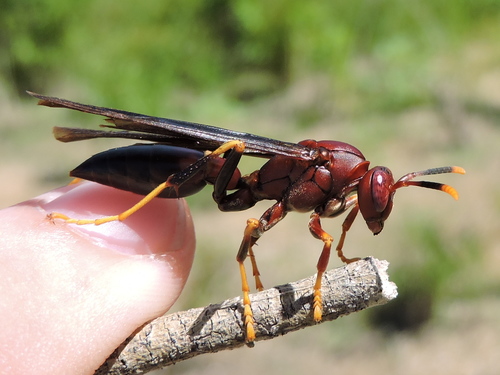
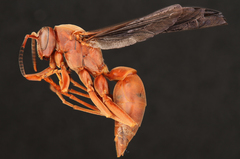
The wasp has a rust-red head and thorax, a mostly black abdomen with one bright yellow ring near the first segment.
Source: Wikipedia
Size
Female fore-wings measure 18.5 to 23.5 mm, males 17.5 to 19.5 mm.
Source: Wikipedia
Is it a pest in the house?
Nests can be placed in sheltered parts of buildings, and birds or raccoons may attack low-hanging colonies.
Source: Wikipedia
Does it bite or sting?
When threatened, it defends its nest with a sting that contains antigen 5, a major allergen.
Source: Wikipedia
How to get rid of it
The nest’s pedicel contains lipids that trigger ants to remove dead material, protecting the nest from ant invasion.
Source: Wikipedia
Where it lives
Nests are attached to branches of trees and shrubs or hidden in sheltered parts of buildings. They prefer the underside of overhangs that stay shaded most of the day, often close to rivers or rocky cliffs.
Source: Wikipedia
What it eats
Adults hunt caterpillars from many moth families in wooded habitats for protein. Caterpillars make up about 20 % of their food; the remaining 80 % is liquid sources.
Source: Wikipedia
Life cycle
In spring, mated females emerge from hibernation in cracks of rocky cliffs. A group of related foundresses may build a single nest together.
Source: Wikipedia
When you see it
Foundresses emerge in spring from cliff cracks and can survive winter conditions, sometimes storing honey before hibernation.
Source: Wikipedia
Lookalikes
It shares many traits with P. exclamans and P. bahamensis in the eastern U.S. It differs from darker P. bahamensis by lacking yellow markings on the mesopleuron.
Source: Wikipedia
Where it is found in the US
Recorded in 33 of 51 states and DC. Most records: Texas, Florida, Georgia, Oklahoma, North Carolina, Alabama, Virginia, Louisiana.
Darker = more records. Counts are museum and citizen-science records, not population size.
Source: GBIF
Status: native in North America. Source: iNaturalist
Months it is reported in the US
Source: GBIF
More photos
Questions people ask
How can I identify a ringed paper wasp?
Look for a rust-red head and thorax, a black abdomen with a single yellow ring near the first segment, and fore-wings about 2 cm long.
Source: Wikipedia
Where are their nests usually found?
They build hidden nests under overhangs on trees, shrubs, or building eaves, often near rivers or rocky cliffs.
Source: Wikipedia
Do they sting?
Yes, they sting when threatened, and their venom contains antigen 5, a common allergen.
Source: Wikipedia
What do they eat?
They hunt caterpillars for protein and drink liquid foods, which make up most of their diet.
Source: Wikipedia
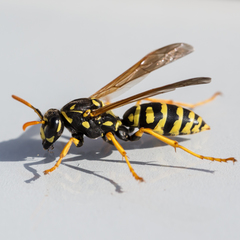
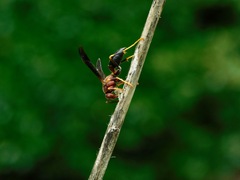
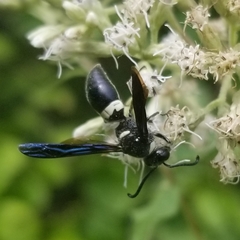
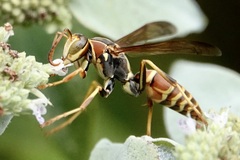
Same family (Eumenidae)

Sources
- Wikipedia: https://en.wikipedia.org/wiki/Polistes_annularis
Look it up elsewhere: GBIF · iNaturalist · BugGuide · Wikipedia
Text written 2026-10-23 from the sources above and checked sentence by sentence against them. Data fetched 2026-10-22.