 Bug FAQ
Red Pierrot
Talicada nyseus · Order: Lepidoptera · Family: Lycaenidae

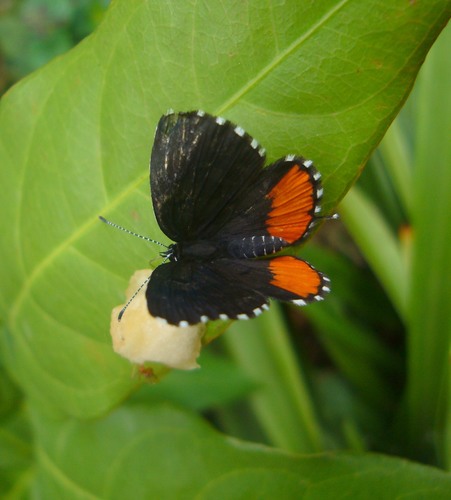
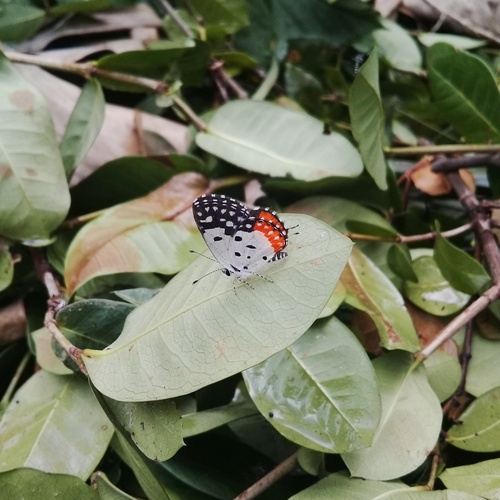
The Red Pierrot butterfly has a wingspan of about 3 to 3.5 cm. Its upper wings are black with a large orange patch on the lower edge of the hindwing, and the underside of the forewing is white with black spots near the margin. It lives where its food plant Kalanchoe grows, from plains up to 8,000 ft, across the Himalayas, India, Sri Lanka and northern Myanmar, and the caterpillars eat the whole leaf by tunnelling inside it.
Source: Wikipedia
How to recognize it
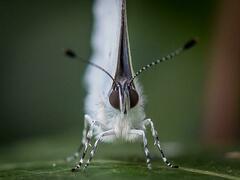
The upperside is black with a large orange area on the lower edge of the hindwing. The underside of the forewing is white with black spots toward the edge.
Source: Wikipedia
Size
Wingspan ranges from 3 to 3.5 cm.
Source: Wikipedia
Where it lives
Occurs from lowland plains up to about 8,000 ft elevation.
Source: Wikipedia
What it eats
Adults visit flowers of herbs, especially Amaranthaceae and Acanthaceae, for nectar. Caterpillars feed on Kalanchoe laciniata and K. pinnata (Crassulaceae).
Source: Wikipedia
Life cycle
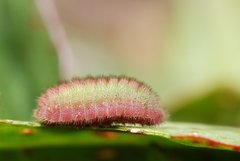
The butterfly is not common overall, but near Kalanchoe it appears in large numbers and groups together at all stages. Caterpillars tunnel through the whole leaf in a winding path, consuming the leaf completely.
Source: Wikipedia
Where it comes from
Native to the Himalayan foothills, North and South India, Meghalaya, Assam, Sri Lanka and northern Myanmar.
Source: Wikipedia
More photos
Same family (Lycaenidae)

Sources
- Wikipedia: https://en.wikipedia.org/wiki/Talicada_nyseus
Look it up elsewhere: GBIF · iNaturalist · BugGuide · Wikipedia
Text written 2026-10-22 from the sources above and checked sentence by sentence against them. Data fetched 2026-10-22.